


The safest-looking network is not always the safest first move.
A polished network homepage, a few famous brand logos, and an Apply Now button can make early approval feel like progress. Often it is only paperwork. A thin site, unclear traffic sources, or a fuzzy monetization plan can trigger rejection, weak account terms, or acceptance into programs that barely match the audience.
The smarter test is fit, not prestige. A content site needs merchants that convert on research traffic; a deal site needs fresh offers and tracking speed; a B2B publisher may need long-cookie or lead-gen programs. Site stage matters too: before applying, there should usually be consistent traffic, visible editorial focus, basic compliance pages, and at least a few pages showing how visitors reach buying intent.
- Early applications can affect future reviews if a network notes past quality issues.
- Merchant mix matters more than brand recognition when audience intent is still narrow.
What an affiliate network actually does
- Affiliate network
An affiliate network sits between merchant and publisher. It tracks clicks and sales, standardizes contracts, handles reporting and payouts, and often enforces compliance—so it is infrastructure, not just a brand catalog.
- Direct affiliate program
A direct program is run by the merchant itself, usually on in-house software or a SaaS platform. Approval, terms, reporting, and payment come from that single brand.
- Agency or outsourced manager
An agency may recruit partners and run day-to-day strategy, but it is not the transaction hub unless it also owns the tracking and payment system. That makes it a service layer, not automatically a network.
- Referral tool
A referral tool usually rewards simple link or code sharing, often for customers rather than publishers. It rarely includes network-style vetting, cross-brand reporting, or more advanced attribution rules.
A publisher joining a network is joining an operating system: one login, shared reporting logic, and centralized payouts across many merchants. A publisher joining a direct program is dealing with one merchant’s rules, tools, and payment schedule only.
From click to payout: how a commission becomes real money
-
The click creates the tracking record
A network link usually drops a cookie or stores another identifier, then logs the click. That record ties a visitor to a publisher, campaign, placement, and often a custom sub ID.
-
The attribution window decides whether the sale still counts
Each program sets a time limit—often 1, 7, 30, or 90 days. If the purchase happens inside that window, the click may still earn credit; outside it, the commission usually expires.
-
Attribution rules choose who gets credit
Many programs use last-click attribution, but some split credit or prioritize specific channels. A coupon site click five minutes before checkout can overwrite an earlier content click if the program allows it.
-
The conversion appears, but it is not final yet
A reported sale often enters a pending or locked state. Merchants validate payment, fraud risk, returns, duplicate orders, and whether the transaction met program rules.
-
Only approved conversions move to payout
After approval, the network adds the commission to the payable balance and releases it on its payment schedule. Minimum thresholds, invoicing rules, and payment holds can delay cash even after approval.
Sub IDs matter because they show which page, email, ad, or placement drove the click. Without them, optimization becomes guesswork.
A tracked sale can still be reversed. Common reasons include canceled orders, refunded products, stolen-card fraud, self-purchases, coupon violations, and leads that fail quality checks.
Practical meaning: dashboard revenue is not income until it clears the lock period and reaches payable status.
Why networks remain popular
For merchants, a network solves several hard problems at once. It brings a ready-made pool of publishers, standard tracking links, contract templates, tax paperwork, and payment handling. Many also provide fraud screening, duplicate-order checks, and compliance monitoring for coupon abuse, trademark bidding, or incentivized traffic.
For publishers, the appeal is just as practical: one login can reveal hundreds of programs, terms, creative assets, EPC data, and approval requirements. Instead of chasing individual managers, a publisher can compare offers quickly and collect earnings in a single dashboard.
- Merchants gain: faster recruitment, cleaner attribution, lower admin workload, and a third party that can mediate disputes.
- Publishers gain: easier discovery, access to brands that do not run public direct programs, and centralized reporting and payouts.
That convenience has limits. Networks charge fees, set tracking rules, and may sit between both parties during negotiations. A merchant often gives up some flexibility on custom deals, while a publisher may face stricter compliance rules, slower approvals, or less direct communication with the brand.
In short, networks reduce friction at scale—but they also standardize the relationship.
Networks and direct programs
Neither model wins by default. A network usually fits best when centralized discovery, one dashboard, standardized tracking, and fewer payment or tax workflows matter most. That tends to help early-stage publishers and anyone testing multiple merchants quickly.
A direct program often becomes more attractive once a publisher has leverage. Brands may offer higher commission rates, longer cookie windows, custom landing pages, or faster access to the team making commercial decisions. The trade-off is more fragmented operations and less built-in support if tracking or payment issues appear.
- Choose networks for speed, comparison, and lighter admin.
- Choose direct deals for negotiation room and closer brand alignment.
The stronger choice depends on traffic quality, bargaining power, and tolerance for operational complexity. That is why the network-versus-direct tradeoff over time rarely produces a universal winner.
What reviewers look for before approving an application
Do networks mainly approve based on traffic size?
Usually not. Modest traffic can pass if the property is real, focused, and clearly maintained. Reviewers care more about legitimacy, audience fit, and whether promotion methods make sense for the offers in the network.
What gets checked during review?
A reviewer typically checks for a working site or channel, clear topic focus, contact or about information, original content, and visible disclosures where needed. They may also look at traffic sources, geography, brand safety, and whether the application explains how links will actually be used.
What tends to trigger rejection or delays?
Thin pages, placeholder domains, copied content, broken navigation, vague traffic claims, and missing policy pages are common problems. So are prohibited traffic methods, misleading incentives, and compliance gaps around privacy, cookies, or disclosures. Many cases that seem mysterious are simply applications that were rejected or left pending because the business model was unclear.
What makes an application look credible?
Consistency matters more than polish. A small but coherent site, recent content, transparent ownership details, and a short, specific description of promotion plans usually inspire more confidence than inflated numbers. Reviewers want evidence that the applicant understands the audience, the traffic source, and the network’s rules.
The fastest approvals usually happen when the reviewer does not have to guess.
Show a real publishing property State traffic sources plainly Match the site topic to likely offers Include basic compliance pages and disclosures Avoid exaggerated metrics or vague plansHow to judge a network before applying
-
Merchant fit
A smaller network with relevant brands often outperforms a famous one full of poor matches. Check category depth, brand quality, and whether top offers fit existing traffic intent.
Look forStrong overlap between the network’s merchants and the audience’s buying behavior.AvoidBig-name network, weak merchant relevance. -
Economics and payout terms
Commission rate means little without reversal rates, lock periods, minimum payout thresholds, and payment methods. Real cash flow depends on how long money stays pending and how often sales are voided.
Look forClear rates, reasonable locks, low thresholds, reliable payment options.AvoidOpaque reversals, long holds, high payout minimums. -
Reporting and tracking
Useful reporting shows clicks, transactions, reversals, and item-level detail with enough speed to optimize. Missing sub-ID support or vague attribution rules makes troubleshooting expensive.
Look forFast reporting, sub-IDs, transparent attribution, detailed status updates.AvoidBlack-box tracking and delayed data. -
Support, geography, and compliance
Good support matters when links break, terms change, or validation stalls. Also confirm country coverage, allowed traffic sources, and how strictly policy violations are enforced.
Look forResponsive managers, relevant geo coverage, written policy clarity.AvoidBoilerplate replies, weak regional fit, selective rule enforcement.
If a network cannot explain attribution rules, reversal reasons, or country restrictions before approval, the mismatch usually gets worse after traffic arrives.
Common traps:
crowded merchant directory, little real fit attractive headline commissions, slow or fragile payouts plenty of dashboards, little actionable detail strict compliance rules enforced only after scale appearsThe tech details that matter later
On day one, almost any decent network can look usable. The gaps usually appear later, when content expands and manual fixes stop scaling.
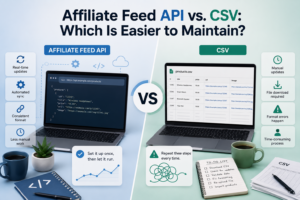
- Deep links send readers to the exact product or category page instead of a homepage. Without them, conversion rates often drop and link maintenance becomes clumsy.
- Feed quality decides whether product-led content can grow cleanly. Strong feeds usually include stable IDs, current prices, stock status, images, categories, and consistent formatting.
- Reporting depth matters once traffic comes from many pages, devices, or countries. Simple totals for clicks and commissions rarely reveal which merchants, placements, or sub IDs are actually working.
- Update frequency affects trust as much as revenue. Slow feeds or delayed reporting can lead to expired prices, out-of-stock recommendations, and poor optimization decisions.
None of this needs to be perfect for a small site. But weak technical infrastructure often becomes the hidden bottleneck that slows an otherwise promising affiliate setup.


-
Narrow the niche
A broad lifestyle pitch rarely survives review. Clear audience, traffic sources, and content format make fit and compliance easier to verify.
-
Fix disclosures first
Privacy, affiliate disclosure, and contact pages should be visible and consistent with actual promotion methods, especially for email, coupons, and paid traffic.
-
Build a realistic shortlist
Favor networks whose merchants match current geography, traffic volume, and content type rather than the biggest names.
-
Read merchant terms line by line
Check bidding restrictions, coupon rules, approval criteria, lock periods, and reversal language before any application goes in.
-
Apply with precise, honest details
Use real URLs, traffic numbers, promotional methods, and examples. Then test a few compliant links, watch clicks-to-approval-to-reversal closely, and scale only when the data stays clean.
Strong applications tend to be selective, documented, and credible. A smaller start with clean disclosures and closely measured tests usually beats a rushed push into multiple networks.










26 responses to “How Affiliate Networks Work: What to Know Before Applying Anywhere”
This was a solid breakdown. The click -> attribution -> validation -> lock -> payout chain is exactly the stuff people skip over on YouTube lol.
One thing I’m curious about: if two affiliates send the same customer to the merchant, is that always last-click attribution, or do networks handle that differently?
Thanks — and yes, that’s one of the biggest hidden details for beginners.
Last-click is still common, but it’s not universal. The merchant or network may use first-click, coupon-code attribution, channel exclusions, or custom rules for existing customers, paid search, or branded traffic. That’s why reading program terms matters so much: the same click can be treated very differently depending on the setup.
I learned this the hard way with a coupon site stepping in at the end 😅 The sale tracked, just not to me.
Small nitpick, but I think a lot of beginner articles make networks sound way more “neutral” than they are.
In reality the reporting can be limited, support can be slow, and you don’t always get much visibility into why something changed. Your article did mention that, which I liked.
Question though: when support quality is bad, is that usually the network’s fault or the merchant’s?
Fair point, and it can be either. If the issue is tracking access, dashboard data, payment processing, or network-level compliance, that usually sits with the network.
If the issue is offer rules, creative approval, product availability, reversals, or custom terms, the merchant often controls the answer. One reason direct programs appeal to experienced affiliates is that they reduce that extra layer of separation.
This is exactly why I prefer dealing direct once possible. Fewer “we’re checking with the partner” emails.
I’m still fuzzy on the “lock period” part.
If a sale shows up in the dashboard, I kind of assumed that meant I earned it already. Are lock periods mainly for refunds/cancellations, or are there other reasons networks wait so long before payout?
I’ve been comparing two networks for the same niche, and your point about reversal risk vs headline commission rate was super relevant.
One has higher advertised rates, but people keep hinting that a lot gets reversed later. The other pays less but seems more stable. As a beginner, should I almost always choose the steadier one first?
Usually, yes. A lower rate with clearer rules and more predictable validation is often better than a flashy rate that collapses after reversals.
Early on, stable feedback helps you learn what’s actually working. If reporting and payout behavior are trustworthy, you can optimize with confidence instead of chasing numbers that never mature into paid commissions.
Steady > sexy rates, honestly. Learned that after waiting forever on a program with “amazing commissions” that somehow never stuck.
Exactly. Headline rates matter, but only after you trust the full path from click to locked payout.
A boring, transparent program is often the better training ground.
The article made networks sound useful but also kind of annoying? Fees, extra rules, distance from the merchant… so why do so many people still push beginners toward networks first?
Is it basically just because discovery is easier there?
Maybe I’m cynical, but “apply honestly and do small tests” sounds nice until you get rejected with a generic email and zero explanation 😂
Do networks ever tell you what specifically was wrong, or is it usually just a black box?
The part about “fit beats prestige” was honestly the most helpful thing here. I kept assuming a big famous network would automatically be better for a small site, but it sounds like that can actually backfire if your traffic is still inconsistent.
Makes sense, just wish more people said that out loud.
Good post. I didn’t realize geo limits could matter that much until you mentioned them.
I get some traffic from Canada and the UK even though my site is US-focused, so now I’m wondering how many clicks I’ve probably wasted already 🙃
Appreciated the section on honest applications.
I feel like there’s weird pressure online to “sound bigger” than you are when applying, but that probably just creates problems later if your methods don’t match what you claimed. Better to be small and clear than impressive and sketchy.
When reviewers check an application, are they actually reading the site manually or mostly just scanning for obvious policy stuff?
I’m asking because my site is real, but it’s still small and I don’t have tons of posts yet.
Usually some mix of both. Many reviewers will do a quick manual check for legitimacy, topic clarity, disclosures, contact/about pages, traffic methods, and whether your content seems genuinely useful rather than placeholder material.
A small site can still be approved if it looks coherent and compliant. Thin content, vague promotion plans, or missing policy pages tend to hurt more than site size by itself.
Beginner question: when you say a network is different from a direct program, does that mean the same brand can have both at the same time?
Like could I apply through a network and also find a direct signup page for that merchant, or is it usually one or the other?
Yes, a brand can absolutely have both at the same time. Some merchants run a program inside a network for discovery, tracking, and admin, while also maintaining a direct relationship with selected partners.
If both exist, you generally want to check which version offers the better terms, support, and flexibility. Just don’t promote the same merchant through two different tracking setups at once unless the program explicitly allows it, because attribution can get messy.
The “tech details that matter later” section hit me because I totally would have ignored stuff like feed structure and reporting granularity.
For someone not super technical, which one becomes painful first when you start scaling: bad reporting, weak deep linking, or slow feed updates?
For most content affiliates, weak reporting becomes painful first because it slows every decision you make. If you can’t see which pages, merchants, links, or geos are producing actual locked commissions, optimization becomes guesswork.
After that, deep linking usually shows up as a practical headache, especially if you publish lots of specific product or category pages. Feed quality matters more once you’re handling larger catalogs, comparison content, or automation.
Seconding the reporting part. Bad dashboards are like doing taxes with oven mitts on.
This cleared up a lot for me, especially the difference between a network, an agency, and a basic referral tool.
I used to lump all of that together as “affiliate platform stuff,” which is probably why half the terminology never made sense.
On merchant-term review: what are the top 3 things you’d check before joining any offer?
Not the whole checklist, just the fastest red-flag scan if you only have a few minutes.
My quick scan would be: attribution rules, reversal/cancellation conditions, and payout timing. Those three tell you a lot about whether a tracked click is likely to become real money.
Right after that, I’d check traffic restrictions and geo limits so you don’t build around a program that quietly excludes your main audience or promotion method.