

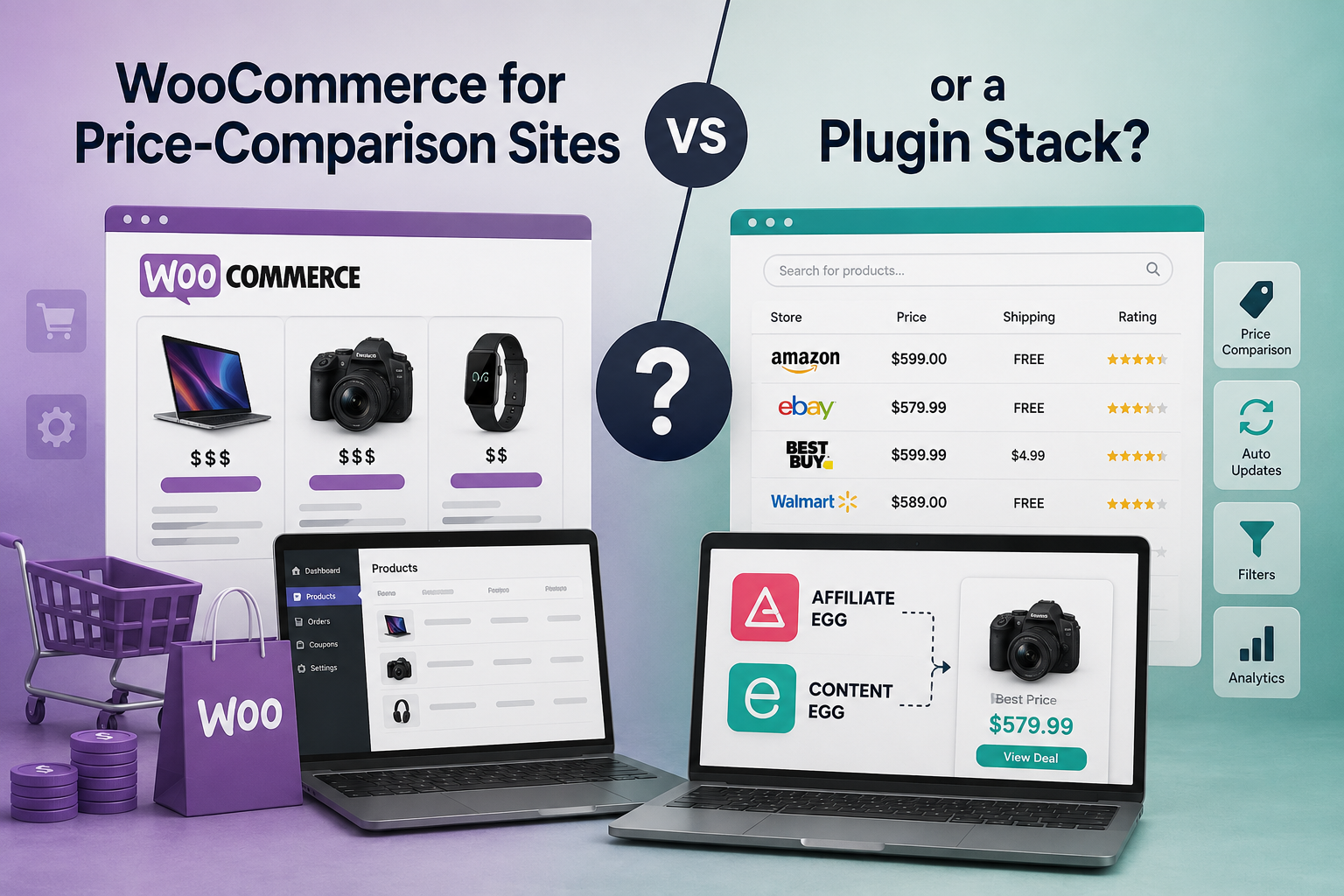
Everything feels manageable until a second merchant feed lands.
The moment one product needs five offers, a shop becomes a data system. Merchant names, stock states, shipping costs, coupons, and affiliate URLs all change on different clocks. WooCommerce can show products; comparison sites must reconcile conflicting offers.
Then SEO joins the bill: faceted filters spawn near-duplicates, stale prices erode trust, and scraped copy muddies canonicals. At that point, the decision is less about plugins and more about workflow architecture.
Content Egg fits feed-based aggregation.
Affiliate Egg helps when offers must be extracted from page markup.
Plain WooCommerce holds up only while offer logic stays simple.
Which route fits fastest?



WooCommerce as the controlled catalog chassis
Best for fully customizable stores
WooCommerce works best when a comparison site is really a curated catalog: a finite set of products, a small merchant list, and an editorial team comfortable updating prices, links, and specs by hand. Its advantage is control. Product types, taxonomies, templates, and schema can be shaped around content needs, while WordPress keeps publishing and SEO workflows familiar. It also handles the awkward category structure for products that belong in several paths better than many add-on comparison stacks.
- Excellent control over data structure and templates
- Mature WordPress ecommerce ecosystem
- Strong fit for editorially curated catalogs
- No native multi-merchant comparison automation
- Manual upkeep grows quickly with more offers
- Requires plugins or custom code for advanced comparison logic
WooCommerce is the safest starting point for a comparison site that behaves more like a carefully managed product library than a live price engine. Once dozens of merchants, frequent price changes, and automated offer matching enter the picture, its limits show quickly.
Content Egg — aggregator-ready offer stack
Top for multi-network offer aggregation
Content Egg suits affiliate comparison publishers pulling offers from many networks and refreshing prices inside editorial pages. Among affiliate WordPress plugins built for comparison publishing, it fits operations that want reusable comparison blocks, imported offers, and post-driven workflows rather than a store-first setup.
- Multi-network imports
- Scheduled price sync
- Reusable comparison blocks
- Editorial-first publishing
- Complex initial setup
- Feed quality varies
Quick take Excellent for large affiliate comparison sites, provided feed mapping, cleanup, and source management are treated as ongoing work.
Content Egg shines when a site behaves like an affiliate publishing operation: many merchants, frequent price changes, and repeatable comparison layouts. The trade-off is real: scaling across sources means deduplication rules, field mapping, and ongoing cleanup become part of daily operations.
Affiliate Egg for feedless merchants
- Covers feedless merchants
- Unlocks niche retailers
- Good for gap-filling
- High QA overhead
Affiliate Egg matters when a comparison site needs merchants that expose no usable API or feed. That can unlock profitable long-tail coverage, but scraped layouts drift, selectors fail, and compliance checks become ongoing work. Best used beside a sturdier feed-based stack, not in place of one.
Run this five-part fit test
-
Check the source
Feeds and APIs suit Content Egg; scrape-only merchants push toward Affiliate Egg.
-
Set refresh tolerance
Hourly price accuracy needs automation; weekly updates can stay lighter.
-
Measure merchant density
One merchant per product favors plain WooCommerce; many sellers justify aggregation overhead.
-
Define the site
Editorial comparisons differ from faceted catalogs with sortable offers and deep filters.
-
Pick the smallest stack
WooCommerce first, then Content Egg, then Affiliate Egg only where feeds fail.
Taxonomies, URL rules, and filter-page indexing should be fixed before import. Retrofitting canonicals and crawl logic later is expensive.
Pick the right core
WooCommerce fits curated catalogs with clear store logic. When the business runs on imported offers, refresh cycles, and multi-merchant data, Content Egg or Affiliate Egg is usually the better core.
Map sources, update SLAs, and page types before choosing. That workflow decision matters more than forcing WooCommerce to act like an aggregator.
Make comparison data fit
For imported offers and live pricing, Content Egg Pro adds the comparison layer WooCommerce usually lacks.








39 responses to “WooCommerce for Price-Comparison Sites or a Plugin Stack?”
The section about SEO control over filter pages hit home.
Everybody loves talking about imports and shiny price boxes, but if category/filter combinations start getting indexed in ugly ways, traffic quality gets weird fast. We had a faceted navigation mess on another project and I’m now irrationally afraid of filter URLs lol.
That fear is rational, honestly. On comparison sites, indexation design should be planned early because faceted pages can multiply quickly and dilute crawl efficiency.
That’s one reason some teams prefer a more controlled core before adding aggressive aggregation.
Faceted URL trauma is real. Search Console starts looking like a horror movie after a while.
Content Egg looked like the obvious winner for me until the article mentioned normalization overhead.
That’s the part nobody wants to budget time for. Importing is fun. Untangling 14 versions of the same product because one merchant used the model number, another used a nickname, and a third wrote a title like it was trying to rank in Google… not fun.
Still, I’d probably choose it over building all that logic around plain WooCommerce.
This was the clearest breakdown I’ve seen on the WooCommerce vs Content Egg question.
I kept trying to force WooCommerce to behave like a true multi-offer comparison engine, and yeah… “controlled catalog chassis” is exactly the phrase. It works until you want automated merchant imports at scale, then suddenly you’re building a little data-cleaning factory on weekends 😂
For anyone who already chose a stack: which one did you end up choosing?
That’s the tradeoff in a nutshell. WooCommerce is great when you want clean control over product structure and SEO, but once merchant count and refresh requirements increase, the missing native aggregation layer becomes the real constraint.
Same experience here. We started with WooCommerce only, then moved to Content Egg because manually keeping affiliate links and prices synced got old FAST.
The “pick the right core” conclusion makes sense, but I do think people underestimate team skill.
A familiar WooCommerce stack with disciplined structure can beat a more specialized setup that nobody on the team really understands. On the other hand, if your workflow is already import-heavy, forcing Woo just because it’s familiar can be a slow-motion mistake.
So yeah… annoyingly, the answer is “it depends” 😄
Which is probably why this article works better than the usual yes/no reviews.
That was my takeaway too. The operational fit matters more than feature checklists sometimes.
Exactly. Tool choice is rarely just about capability in isolation; it’s about what your team can run reliably over time.
Feature checklists sell plugins, but workflows decide whether the site survives.
For a coupon-ish / deals hybrid site, would you still pick Content Egg WordPress Affiliate Price-Comparison Plugin as the core?
We’re not a pure comparison engine. More like editorial deal pages, merchant widgets, and occasional side-by-side offer blocks. I can’t tell if that means WooCommerce is enough or if I’d regret not starting with the aggregator-first route.
For a deals/editorial hybrid, I’d decide based on how central structured multi-merchant data will be six months from now, not just at launch.
If comparison blocks are occasional and content leads the experience, WooCommerce may be sufficient. If reusable offer data is going to spread across many pages and merchants, starting with Content Egg can prevent a rebuild later.
We thought we were “mostly editorial” too, then the offer blocks started taking over the site. Wish we’d planned for that earlier.
Question on deduplication: when multiple merchants use slightly different product titles, is Content Egg decent enough out of the box, or do you basically have to normalize everything manually?
That part always gets glossed over in “build a comparison site” articles, but it’s where projects go to die lol.
Out of the box, it helps with aggregation, but it doesn’t eliminate the normalization problem. If merchants use inconsistent naming, attributes, or model references, you’ll still need a process for mapping and merging offers into a unified catalog.
Yep. The plugin gets you data, not clean product truth. Learned that one the expensive way.
So if I understand right:
– WooCommerce = better catalog control
– Content Egg = better offer aggregation
– Affiliate Egg = useful when merchants are feedless but comes with more headaches
If that’s the summary, then I appreciate the honesty because too many reviews pretend scraping is some magic easy button.
I’m a little more skeptical on Affiliate Egg than some people here.
Not because it can’t work, but because every time scraping is involved, somebody on the team eventually becomes the unpaid detective of broken selectors, layout changes, geo variations, and random merchant weirdness.
Maybe that’s fine for a handful of high-value stores. At scale? Ehhh.
That skepticism is fair. Affiliate Egg can unlock merchants you otherwise couldn’t include, but it shifts the workload from feed handling to maintenance and monitoring.
So the question becomes whether those additional merchants are valuable enough to justify the fragility.
Exactly. Great for coverage, not always great for sleep.
One thing I liked here was the point about refresh SLA.
People jump straight to features, but if your niche needs near-fresh pricing and availability, the wrong stack becomes obvious pretty quickly. We run in electronics and even a modest delay creates “why is this price different” emails from users.
Refresh expectations are one of the best early filters. If users expect current pricing and frequent changes are common, your ingestion method and monitoring matter as much as front-end presentation.
100%. Visitors blame *you* when a merchant price changed 20 minutes ago. They do not care how clever your stack is.
The five-part fit test was actually more useful than the product sections for me.
Our issue is source type: half the merchants give feeds, half don’t. That makes the clean “just use Content Egg” answer a little messy. Did you mean a mixed stack with Content Egg + Affiliate Egg is normal, or only as a last resort?
A mixed stack is pretty normal when your merchant landscape is uneven. Content Egg handles the feed/API side more cleanly, while Affiliate Egg fills the gaps for merchants without feeds.
The caution is operational overhead: once scraping enters the picture, QA, selector maintenance, and compliance checks become ongoing work rather than a one-time setup.
We run that exact combo. It works, but “works” means someone on the team checks broken selectors way more often than we’d like 😅
I still lean WooCommerce for smaller vertical sites.
If you’re only tracking a curated set of products and you care a lot about custom landing pages and tight control over filter-page indexation, the WordPress/Woo stack feels less chaotic. Not as sexy, not as automated, but less chaos.
The proof stats / fast-fit section was useful because it saved me from overthinking this.
My take after reading: if you already know you’re building a comparison site, stop trying to be clever and start with the stack made for aggregation. If you mostly want a controlled product content site with some monetized offers, WooCommerce can still make sense.
Did I oversimplify that too much?
No, that’s a solid simplification. The only caveat is that source quality and merchant type can still override the obvious choice, especially when feedless merchants are strategically important.
Pretty much how I read it too. Not every project needs the full aggregator toolbox on day one.
Minor rant: a lot of “comparison site” tutorials act like data cleanup is optional.
This post at least admitted the ugly bits—dedupe, link maintenance, compliance, filter-page SEO. That’s the real project, not the plugin install screen.
Which one did you end up choosing for your own projects though? The article stays balanced, which is good, but I was still waiting for the “ok here is what I’d actually deploy first” answer.
My instinct says Content Egg if the goal is price comparison from day one, but WooCommerce if the site starts more editorial and grows into comparison later.
That’s basically my view. If the business model is clearly a multi-offer comparison site from the start, Content Egg is usually the faster fit because the data workflow matches the goal better.
If the site begins as a controlled content/catalog project and aggregation is secondary or later, WooCommerce can be the safer starting core.
We did exactly that progression: editorial first with Woo, then added comparison functionality later. I wouldn’t choose that route for a pure comparison launch though.
We tested WooCommerce Open-Source WordPress Ecommerce Plugin Powerhouse first because the team already knew WordPress really well.
That familiarity helped a lot on the content side, but once we tried to present multiple merchants per product in a clean, scalable way, it felt like we were adapting a store plugin into a comparison database. Possible? Sure. Elegant? Not really.
Curious if anyone stayed on Woo long term and was actually happy with it.
We stayed on it for a niche catalog with maybe 300 core products and limited merchants. For that size, happy enough.
That’s usually where WooCommerce remains comfortable: tighter catalogs, fewer merchants, and stronger emphasis on content control than broad aggregation.
Once merchant count grows, the pain curve gets steep. At least that was our experience.