

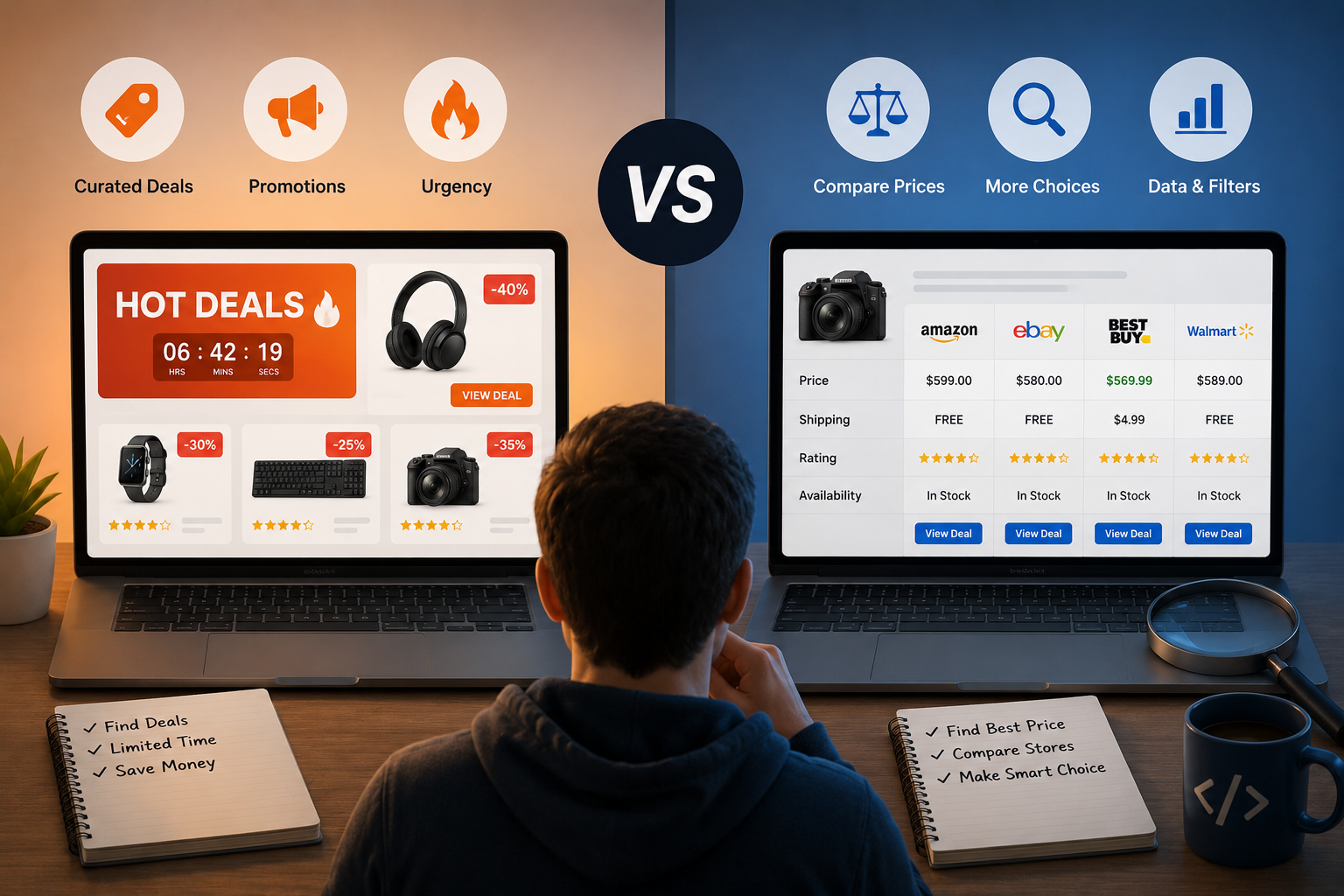
The wrong format can quietly become a second full-time job.
Monday starts with three expired coupon complaints, two merchant feed errors, and a sponsor asking why yesterday’s top slot underperformed. For a smaller team, the choice is less about feature appeal than about operating load.
A deal site demands constant editorial triage, moderation, fraud checks, and fast refresh cycles once revenue depends on volume. A price comparison site shifts work toward feed ingestion, matching, normalization, and tracking accuracy. The real danger is choosing the model whose daily maintenance outgrows the team just as traffic and monetization pressure peak.
Best fit for a smaller team


|
Deal model
Slickdeals: Community-Powered Deals, Coupons, and Alerts
|
VS |
Comparison model
Google Shopping: Cross-Merchant Price Comparison and Listings
|
|---|---|---|
|
Very fast
|
Launch speed |
Slower setup
|
|
Editorial triage
|
Core workload |
Feed management
|
|
Spiky
|
Traffic pattern |
Evergreen
|
|
Promo-led
|
Monetization fit |
Buyer intent
|
|
Consistency
|
Breaks first |
Price sync
|
| Compare | Compare |

Launching comparison pages on WordPress?
Content Egg Pro helps smaller publishers run real comparison pages without hand-updating prices, products, and tables across every article.
Slickdeals for deal-led teams
Top choice for crowd-sourced bargain discovery
Slickdeals fits lean teams that are better at spotting fast-moving discounts and packaging them into posts, alerts, and conversation than maintaining clean commerce data. It rewards editorial instinct and community momentum more than catalog normalization.
- Community finds deals
- Low catalog overhead
- Urgency drives clicks
- Stale deal risk
- Heavy moderation load
- Trust erodes fast
Quick take This model shines when speed and taste matter more than structured product depth. The real burden is moderation, freshness, and credibility.
For a smaller team, Slickdeals shows why a deal site can be easier to run than a comparison engine. Community submissions expand coverage, but success depends on timing, comment quality, and protecting trust when offers expire or disappoint.
A deal site swaps structured product matching for social proof and urgency. That cuts data maintenance, but raises the cost of moderation, alert tuning, and editorial judgment.
Price-comparison benchmark: Google Shopping
Best for quick side-by-side price checks
Google Shopping shows why comparison pages age better than flash deals. It aggregates merchant listings and prices across retailers, then captures shoppers already in decision mode: checking sellers, price gaps, and availability. Because that intent repeats, the traffic profile is steadier than promotion-led spikes.
The real workload sits behind the page: catalog normalization, entity matching, merchant deduplication, price freshness checks, and affiliate routing. That sounds heavy, but unlike deal curation, these systems are reusable. One template can support brand pages, retailer pages, and comparison formats such as WooCommerce versus a plugin stack, with the same data blocks filling new URLs.
Comparison content aligns with lasting buying intent, so older pages can keep earning visits and commissions. Once feeds, matching rules, and page templates are in place, output scales more predictably than a constant stream of new deals.
Pick the model that matches the first traffic source
-
Choose by acquisition, not preference
A deal site fits social, email, communities, and fast-moving promotions. A price comparison site fits search-driven buying intent, where structured pages can rank and convert steadily.
-
Launch in one tight category
One merchant group, one product type, or one local vertical is enough. Narrow scope keeps tagging, page templates, and editorial rules simple enough for a small team to maintain.
-
Prove a single revenue path first
For deals, that may be affiliate clicks on a few repeat merchants. For comparison, it is usually affiliate or lead-gen on a small set of high-intent pages.
-
Keep the first version operationally small
If daily publishing, moderation, feed cleanup, or price matching cannot be handled in a few hours, the scope is still too wide.
-
Expand only after repeatability appears
Add categories, merchants, or content formats only when traffic, conversion, and update workflows are stable for several weeks.
Still undecided? The links below help narrow the niche and map the build before committing.
Recommendation
For most smaller teams, a comparison site is the better default. Its pages compound, the data model can be templatized, and refresh work becomes increasingly automatable as coverage expands.
A deal site only wins when the team can surface timely offers more reliably than larger publishers and sustain that pace without trust erosion.
Ready to automate comparison pages?
Content Egg Pro helps smaller teams run the model that scales: import merchant data, sync prices and availability, and publish structured comparison blocks without building a custom stack.











16 responses to “Deal Site vs Price Comparison Site for a Smaller Team”
This was actually one of the clearer takes I’ve seen on this. A lot of people talk about deal sites like they’re “lighter” because you don’t need a huge product catalog, but the moderation/trust workload is very real.
For a 2-3 person team, Google Shopping feels more realistic *if* someone can handle the data cleanup and feed logic. If not, I can totally see Slickdeals-style publishing being easier for the first few months and then becoming chaos later.
The Google Shopping comparison made sense, but I wish the article went even deeper on the “hidden data systems” part.
Because that’s really the catch, right? Comparison sites look calm from the outside, but behind the curtain it’s feeds, matching, duplicate cleanup, missing prices, merchant weirdness, all that fun stuff.
So yeah, more scalable in theory, but only if your tooling isn’t held together with tape 😂
Totally fair. “More scalable” doesn’t mean “easy.” It means the work is more reusable once the system is stable.
With deal sites, the effort often repeats every day through sourcing, writing, moderation, and trust management. With comparison sites, the pain is more front-loaded into structure, normalization, and sync reliability.
As someone who spent two months fixing feed errors… can confirm this is not magical passive income haha
Maybe I’m the odd one out, but I still think Slickdeals wins if the team is super plugged into a niche and can move fast. Not everything needs a beautiful data system on day one.
That said… once sponsors start nudging coverage and traffic spikes hit, yeah, I can see the wheels wobbling. The article was fair about that.
I appreciated the warning about sponsor pressure. That part felt very real.
A deal site can drift fast if the team starts optimizing for what partners want instead of what users actually trust. Then moderation becomes a mess because readers smell the bias instantly.
We ran a mini deal newsletter for about 6 months and the “community lift” part is true… until it isn’t. Once people start submitting junk or borderline expired offers, somebody has to police the quality constantly.
So for my use case, Slickdeals-style is better if you already have an active audience and someone who enjoys the moderation side. If you’re building from search first, I’d pick the Google Shopping model every time.
Short version: deals are more fun, comparison is probly more sustainable.
The part about matching the model to the *first traffic source* was the most useful bit for me.
If your traffic is coming from search, comparison pages make way more sense than trying to force urgency-driven deals into an evergreen SEO setup. I’ve seen small teams ignore that and then wonder why they’re exhausted + not growing.
Exactly. A lot of the operating pain comes from trying to run a model that doesn’t match how visitors first arrive.
Search traffic tends to reward reusable comparison templates and structured data, while deal-led traffic usually needs editorial speed, freshness, and community momentum.
Yep, this. We tried to do both at once and it was honestly dumb lol. Search pages kept performing long after publish, while deals died in hours unless we kept pushing them.
That’s a common trap. Doing both too early sounds diversified, but for a small team it usually doubles the maintenance before either model is really working.
Which one did you end up choosing in practice for smaller publishers you’ve worked with?
The recommendation says comparison is the default winner, but I’m curious if that changes when affiliate revenue is weak early on. A deal site can sometimes get quicker engagement, even with less structure.
I guess I’m asking whether Google Shopping-style pages still win when the team is tiny *and* not technical.
In most cases, I’d still lean comparison first, but with a very narrow scope. The key is not “build a giant comparison engine,” it’s “publish a small set of structured pages you can maintain reliably.”
If the team is non-technical, the deciding factor becomes tooling. If imports, syncing, and updates are mostly handled by the stack, comparison can still work. Without that, the recommendation gets weaker and a deal-led format may be easier short term.
This is where I landed too. Tiny niche, 40-ish pages, very boring setup, but it kept working. When we tried deals, it felt exciting… and then immediately turned into weekend work 😅
That tradeoff is exactly it. Deal-led models often feel more alive early, but they can quietly create a much harsher operating schedule for small teams.
Good article, but I think some founders will read “comparison is the default winner” and underestimate how much bad merchant data can wreck the experience. I’ve seen price pages that were basically stale junk after a few weeks.
Still, I agree with the broader point: that problem is at least system-fixable. Editorial burnout on a deal site is harder to solve with a tiny team.