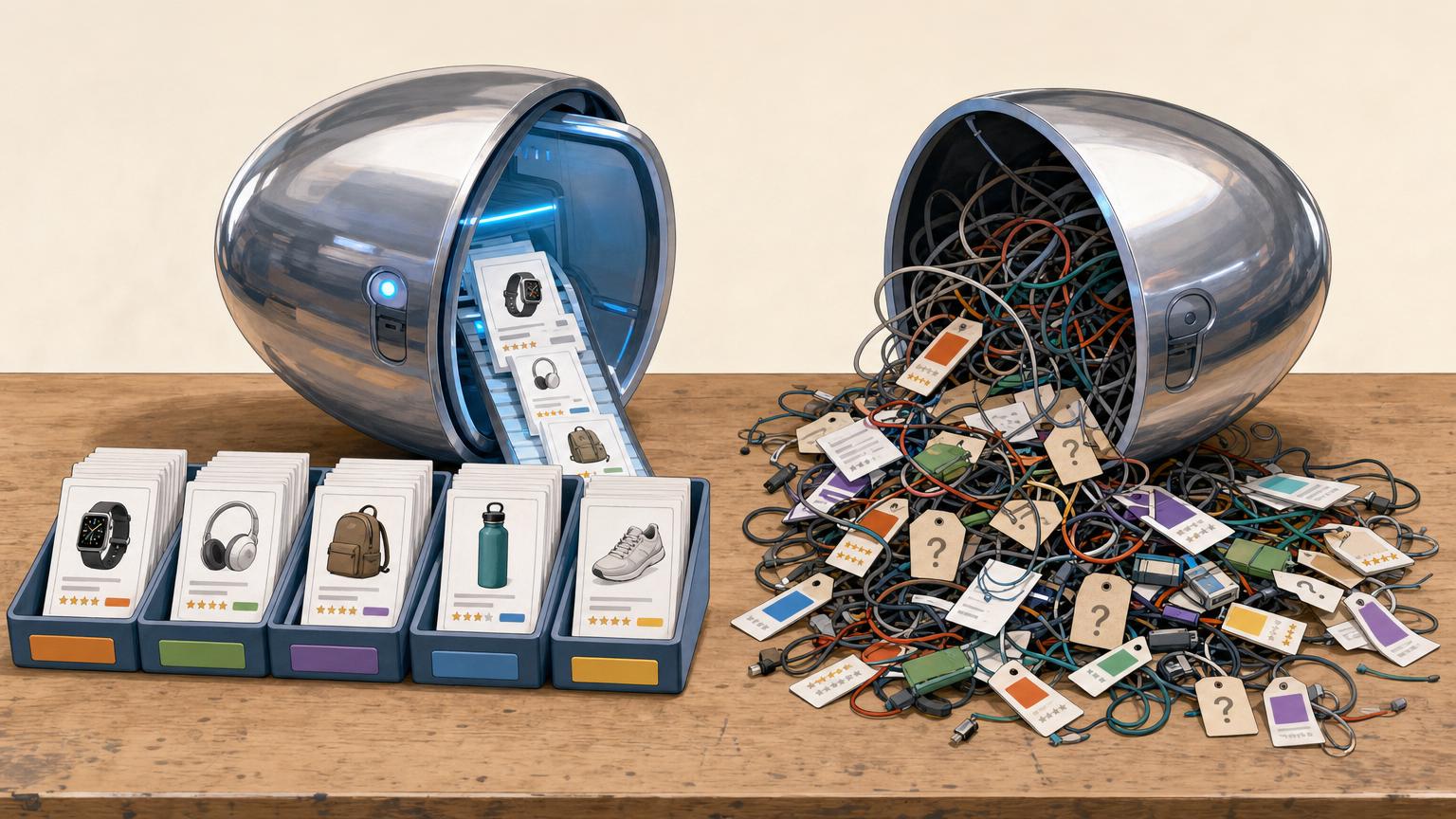


Rankings can stay strong long after the sale has already died.
A review page can keep pulling steady traffic for months after a product disappears. The rankings look healthy, the clicks keep coming, yet the visitor arrives ready to buy and meets Out of Stock. That is not a small conversion leak; it is purchase intent being cut off at the last second.
The temptation is to replace the link with anything close and move on. But a sloppy swap can damage relevance, trust, and commission value if the specs, price band, or retailer quality drift too far. The real requirement is FAST action without careless substitution.
Diagnose the stock event first
Before any automation replaces a link, the target failure needs a label. A product that is briefly unavailable should not be treated like a dead page or a retired SKU. This is also the right moment to refresh price and availability signals, since stale feeds often create unnecessary swaps.
- Temporary OOS: the page still loads normally, pricing is consistent, and stock has recently flipped in and out.
- Seller-level issue: one merchant is gone, but the marketplace page still has other live offers.
- Variant-level issue: only a size, color, or capacity is missing, while the parent product remains healthy.
- Discontinued item: repeated stockouts, no recent offers, and signs that a newer model has replaced it.
- URL move or page error: redirects, 404/410 responses, bot blocks, or retailer glitches point to a linking problem instead.
No single signal is safe enough on its own. Reliable classification comes from combining page text, structured data, HTTP status, redirect behavior, offer count, and recent inventory history. That extra verification prevents false swaps that replace a strong product simply because one seller vanished or one variant sold out.
Out of stock text can be misleading. Retailers reuse templates, hide offers behind location checks, or fail to load inventory widgets. A replacement should happen only after multiple signals agree.
Automate only exact matches
The safest automation lives in a very narrow zone: the item is identical, and the recommendation being made is still true. If the article praised a specific camera, razor, or air fryer, the replacement should point to that exact model—not a newer generation, bundle, color, or capacity.
Low-risk automatic replacements usually fit one of these patterns:
- Same product, new URL: canonical path changed, but brand, model number, GTIN/UPC, and retailer match.
- Same PDP, different in-stock offer: the product page is unchanged and the buy box shifts to another seller that still meets marketplace quality rules.
- Same SKU surfaced through a cleaned link: affiliate parameters, mobile URLs, or tracking redirects differ, but the destination product is identical.
- Same manufacturer identifier across mirrored listings: duplicate pages resolve to one item with matching MPN/ASIN/EAN and the same core specs.
A simple rule keeps automation honest: if the editorial sentence could be copied over word for word after the swap, the replacement is probably safe. If any claim about size, finish, included accessories, generation, or performance needs updating, it no longer belongs in the automatic bucket.
When another merchant is truly interchangeable
An alternate merchant is genuinely safe only when the replacement is the same buyable item, not a nearby lookalike. The hard check is identical GTIN, MPN, ISBN, or brand-plus-model, with the same size, color, pack count, and hardware revision. If any of those drift, automation stops being substitution and starts becoming recommendation.
Several filters decide whether the match still respects buyer intent:
- Region: the offer must ship to the visitor’s country, in the expected currency, without surprise taxes or import friction.
- Fulfillment: marketplace listings can share the code yet differ on delivery speed, warranty coverage, and returns.
- Merchant trust: suppress sellers with weak ratings, thin policies, or suspicious price gaps.
- Freshness: an in-stock flag may already be stale; replacement quality depends on how quickly the merchant feed refreshes.
A swap that passes identifier checks but fails these filters only looks safe. Strong systems rank exactness first, then reject offers that reduce delivery certainty or post-click confidence.
Similar products need hard limits
Comparable-product swaps are safest only on broad-intent pages, not model-specific ones.
A gift guide or “best” roundup can absorb alternatives. A review of one exact product cannot; swapping changes the page promise.
Automatic replacements need a tight price band, usually about ±10–15% unless the page already spans tiers.
Big jumps break expectation, distort conversion history, and turn a value click into sticker shock.
Critical specs and use-case fit must match before any swap is allowed.
Size, capacity, power, compatibility, audience, and included features decide whether the product is actually suitable.
Ratings matter only after price, specs, and use-case checks pass.
A highly rated product for the wrong workload is still wrong. Review count, seller quality, and complaint patterns still matter.
Stop automated swaps here
Automation should pause the moment a swap would alter the original recommendation rather than simply restore availability.
- Condition changes: new to refurbished, used, open-box, renewed, or marketplace-only.
- Package changes: body-only instead of kit, missing accessories, smaller quantity, shorter license term, different storage tier.
- Meaning changes: another generation, different chipset, sensor, material, interface, or compatibility standard.
- Value changes: higher total cost after shipping, weaker warranty, worse return terms, slower fulfillment, or lower seller trust.
- Claim changes: the page praised quiet operation, USB-C charging, or works with HomeKit and the substitute no longer does.
A simple rule helps: if the sentence recommending the product would need editing, the link should not change itself. That includes bundles, ecosystem lock-in, safety gear, supplements, and anything where a small spec difference creates a very different buyer outcome.
A replacement can be in stock and still be wrong. When condition, compatibility, included items, or buyer protections move, send the link to human review instead of guessing.
Build the replacement engine to fail safely
-
Score every candidate before any swap
Assign a confidence score from identifier match, feed freshness, merchant trust, region, fulfillment, and landing-page parity. Hard-block anything that changes claims, condition, or compatibility.
-
Run fallbacks from lowest risk to highest
Start with same-item URL repair, then same-SKU variant recovery, then exact in-stock merchant substitutes. Similar products belong in a lower tier and should run only on broad-intent pages.
-
Suppress when certainty is not high enough
If no option clears its threshold, remove or disable the buy CTA and show an unavailable state instead. A missed replacement costs less than a bad redirect.
-
Preserve attribution and destination integrity
Rebuild links from canonical tracking templates, then verify tags, sub-IDs, locale, and deep-link targets before publish. Avoid passing through scraped outbound URLs.
-
Log every decision and keep rollback instant
Store the trigger, evidence, score, old URL, new URL, and any reviewer override. Version each change so a bad rule or stale feed can be reversed in minutes.
Use asymmetric thresholds: lower for repairing an obvious exact-match link, higher for switching merchants, and highest for any comparable-item fallback. That pattern keeps the logic aligned with a larger affiliate content automation system and makes tuning safer over time.
A simple operating policy
Keep earnings by protecting trust
- Review suppressed links on a fixed cadence.
- Log every swap, mute, and rollback.
The safest policy is simple: monetize only when the replacement is clearly defensible. When certainty disappears, a muted link beats a misleading one.
Pages that keep earning usually have quiet maintenance behind them: stock monitoring, review queues, and regular cleanup.











15 responses to “Out-of-Stock Affiliate Links: What to Replace Automatically”
Good article, especially the reminder that region and fulfillment matter when changing merchants. An in-stock offer is not really interchangeable if it ships in 3 weeks from a sketchy seller.
One thing I’d add: rating thresholds can be tricky when you replace with a similar product.
Sometimes the substitute has a slightly lower rating but way more reviews, better recent review velocity, and fewer return complaints. Purely numeric guardrails can miss that nuance.
Agreed. Ratings work best as one constraint, not the whole decision. If a site allows comparable swaps at all, the score should be combined with review count, recency, return signals, and whether the use-case still matches the original recommendation.
I liked the hard line on only automating exact matches.
A lot of affiliate folks act like swapping to a “close enough” item is harmless, but if the specs drift even a little, conversion drops fast. We learned that the annoying way after replacing a 256GB model with a 128GB one because the title looked similar in the feed 😬
The cleaned-link idea sounds simple, but it solved more than I expected for us. Sometimes the item was still in stock and the real problem was a junk URL parameter or an old merchant redirect chain.
I wish more people talked about total value, not just sticker price.
If your replacement is $5 cheaper but loses accessories, warranty, or bundle contents, that’s not a real substitute. Users notice. They always notice lol.
Yes — that’s exactly where automation should stop. Once package contents, warranty terms, or overall value change, the swap stops being mechanical and becomes editorial.
“Stop automated swaps here” was my favorite section.
Condition changes are where things get messy. New vs refurbished vs open-box is not a small detail, and I’ve seen sites pretend it is because the commission still tracks. Not great.
This is one of the few posts on affiliate automation that didn’t oversell the magic.
The simple operating policy at the end actually felt practical: mute low-confidence links, review risky ones manually, and keep logs. Not sexy, but probably better than pretending an algorithm can understand every product edge case.
Thanks — that was the goal. In this area, restraint usually outperforms cleverness.
A boring system with good logs and clear manual checkpoints tends to protect trust and revenue better than an aggressive swapping engine.
The point about diagnosing the stock event first is HUGE. We were replacing links too aggressively and half the time it was just a temporary retailer glitch or a variant going weird, not a real out-of-stock situation.
We started requiring exact identifiers before merchant swaps, and it cut our bad replacements a ton.
Before that, matching by title alone was causing some ridiculous substitutions. Same brand, similar name, totally different model year. Close enough for a feed, not close enough for a buyer.
Exactly. Title matching is useful as a clue, but it’s too weak as the final decision rule. Exact identifiers plus seller quality and feed freshness checks are what make another merchant truly interchangeable.
Versioned logging is the boring part nobody wants to build until a bad swap goes live lol.
We had one weekend where a feed issue changed merchant availability and our script swapped dozens of links to worse sellers. If we hadn’t kept old link states, rollback would have been a nightmare.
The section on similar products needing strict guardrails should honestly be pinned above every affiliate dashboard.
Broad-intent roundup pages? Sure, maybe. But on pages where the click intent is clearly for one exact item, a “similar” replacement can feel kinda scammy even if the substitute is decent.