

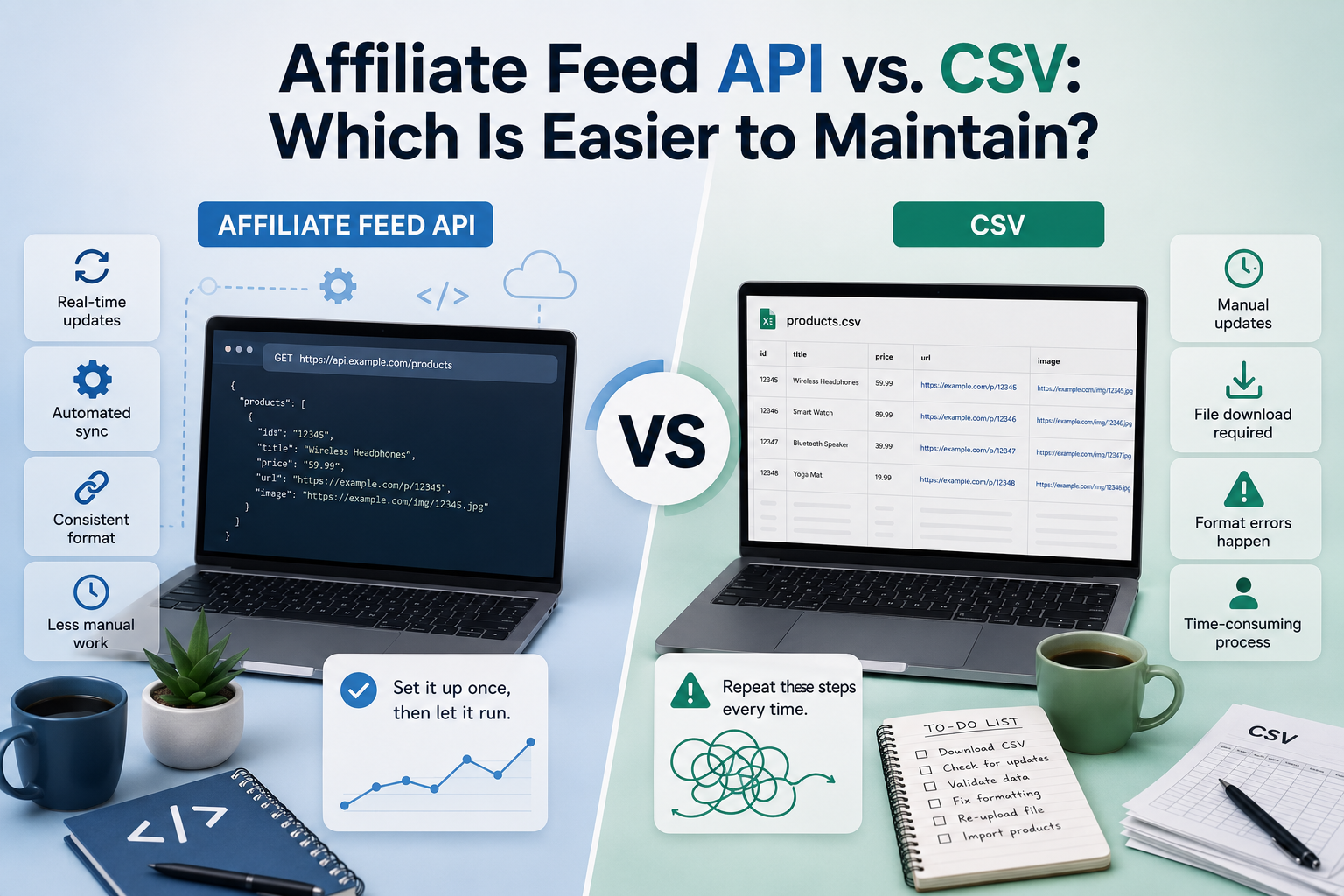
The hard part starts after launch, when a “working” feed quietly stops being trustworthy.
A catalog can look fine on Monday and be broken by Tuesday morning: a merchant renames a column, drops image URLs, changes currency formatting, or pauses half a category without warning. Suddenly imports fail, old prices linger, and someone is backfilling missing fields by hand.
That is why the real comparison is not API versus CSV on paper. It is how often the pipeline needs babysitting once merchants, networks, and schemas start drifting. The easier format to maintain is the one that absorbs small upstream changes without turning routine updates into recurring cleanup.
The easier format is the one that behaves well in production
-
Predictability
Maintainable feeds change in controlled ways: stable fields, version notes, and explicit deprecations. Surprise schema drift is what turns routine refreshes into fire drills.
Look forStable contracts, typed values, documented changesAvoidSilent renames, mixed data types, undocumented removals -
Debuggability
When something breaks, the team needs a fast path to the cause. Clear errors, timestamps, counts, and source-level traceability matter more than initial convenience.
Look forLogs, status codes, row-level clues, reproducible failuresAvoidBlack-box imports, vague errors, no provenance -
Recovery effort
A good pipeline fails safely and resumes cleanly. Retries, partial reprocessing, and idempotent updates keep one bad run from becoming a cleanup project.
Look forIncremental sync, safe replays, automatic retryAvoidFull reimports, duplicate records, manual rollback -
Ongoing touch
The easiest option is usually the one that can be ignored most days. If normal updates require remapping, spreadsheet edits, or spot-checking, maintenance is already expensive.
Look forMostly automated runs with light reviewAvoidRecurring manual fixes and babysitting
How CSV upkeep really works
At first glance, CSV looks low-maintenance: fetch a file on a schedule, parse rows, map columns, and load the database. For small, stable catalogs updated once a day, that pipeline can stay pleasantly boring.
The strain appears when the catalog grows or changes frequently. CSV is usually batch-oriented, so each refresh means downloading the whole file, reprocessing unchanged rows, and waiting for the import window to complete. A renamed header, stray delimiter, broken quote, or encoding shift can stop the job cold.
Where upkeep accumulates
- Scheduling: retries, timeouts, and partial downloads need safeguards.
- Normalization: currencies, categories, availability, and image fields often arrive in inconsistent formats.
- Import logic: duplicate IDs, missing required columns, and delete handling create cleanup work.
- Diagnosis: problems are often discovered after the batch finishes, not when the source changed.
As volume rises, teams usually add row-count checks, schema validation, checksums, and homemade delta logic just to keep the pipeline dependable.
CSV stays manageable when the source is disciplined. Once suppliers change columns or publish malformed rows, maintenance shifts from setup to constant exception handling.
What API upkeep looks like after launch
APIs usually demand more discipline at the start. Someone has to handle authentication tokens, pagination rules, and rate limits, then define behavior for timeouts, partial responses, and 429 errors.
After launch, the maintenance work becomes operational rather than clerical. A healthy integration typically includes:
- Retries with backoff for temporary failures
- Idempotent syncs so the same update can run twice safely
- Incremental fetches using cursors or
updated_sincefields - Monitoring and alerts for error spikes, stale jobs, and sudden item-count drops
This is where APIs often become easier to live with than CSV. Instead of re-importing an entire catalog and cleaning up the fallout, the system can pull only changed records, resume from the last checkpoint, and fail in smaller, easier-to-debug units.
The tradeoff is clear: more moving parts upfront, but less repetitive maintenance once the sync logic is disciplined.
The real win comes from stateful syncing: token refresh handling, saved cursors, clear logs, and alerts before data goes stale.
The maintenance winner changes by failure mode
Freshness is usually easier to control with APIs.
Batch files create predictable but often long stale windows. APIs can pull deltas, track sync lag, and update fast-moving products without reloading the whole catalog.
Failure visibility matters more than the transport format.
CSV problems often surface after a full file lands and parsing starts. APIs expose request-level errors, rate limits, timeout patterns, and endpoint-specific alerts much earlier.
Schema drift is risky in both, but API changes are often easier to detect.
Header renames or column shifts in CSV can silently break mappings. Versioned endpoints, typed responses, and deprecation notices usually give clearer change signals.
Scaling pain depends on how much unchanged data gets reprocessed.
Large CSV jobs repeatedly download, store, parse, and retry entire catalogs. APIs may add call overhead, but incremental syncs cut waste when only a fraction changes.
Partial-error recovery is far cleaner with well-designed APIs.
CSV workflows often require file-level reruns, sidecar exception files, or manual patching. APIs can skip, retry, quarantine, or replay individual records without replaying everything else.
When CSV is genuinely easier
CSV still earns its place when the catalog is small, changes are infrequent, and the business prefers fixed snapshots over continuous sync. In those cases, a nightly or weekly file is easier to reason about than a live integration, especially when affiliate feed update frequency is modest.
Its biggest advantage is determinism:
- one file represents one moment in time
- imports can be tested before publishing
- rollback is as simple as restoring yesterday’s file
- non-technical teams can inspect rows in familiar tools
That matters for batch workflows such as seasonal promotions, curated assortments, or partner catalogs that rarely change. CSV may be less fresh, but it can be calmer: fewer moving parts, clearer approvals, and predictable recovery when a bad update slips through.
When APIs become simpler
An API usually becomes easier to maintain when the catalog changes too quickly for batch snapshots to stay trustworthy. Frequent price moves, stock churn, and merchant-level overrides are easier to handle when the system can fetch only changed records, re-sync a single store, or retry one failed page instead of rerunning a full import.
It also tends to pull ahead in multi-store environments. Each source may bring different fields, limits, and update patterns; with solid adapters and monitoring, one troublesome merchant can be isolated without disrupting every other feed.
The real advantage appears only when the platform is built for it:
- Selective ingestion cuts bandwidth, storage, and unnecessary reprocessing.
- Automation around retries, caching, idempotency, and schema mapping turns API complexity into routine maintenance.
- Source quality still decides the outcome: a messy API can be harder to live with than a clean, stable CSV.
The maintenance iceberg
Format debates often miss the work that sits around the feed. A CSV can look simple because the parser is simple, while the harder jobs move downstream: normalization of categories, currencies, and availability flags; caching to prevent full-site churn during refreshes; and image pipelines that dedupe, resize, and detect broken assets.
An API does not remove those chores. It just exposes them earlier, often with better timestamps and record-level signals. That is why maintainers should model the whole ingestion path, including tradeoffs between network feeds and direct programs, not only transport format.
- If attributes arrive inconsistently, normalization dominates cost.
- If images change often, media handling becomes the bottleneck.
- If alerts are weak, both CSV and API failures stay invisible until revenue drops.
Publishing is where upkeep compounds
Downstream, the real maintenance bill often appears after ingestion. A tidy API can still become high-touch if products must be reshaped for templates, deduplicated, enriched, and republished through brittle CMS logic. A plain CSV can feel effortless when the transform layer is stable, publishing is idempotent, and every refresh can be rolled back cleanly.
- Low-maintenance pipelines usually include delta detection, queue-based publishing, cache invalidation, and image retries.
- The choice between a WordPress plugin and Zapier-style publishing can matter more than feed format, because connector limits, field mapping, and scheduling rules decide how often humans step in.
When refresh jobs are observable and safe to replay, CSV and API both become manageable. When publishing is opaque, either format turns expensive.
Choose the format that matches current operating reality
-
Start with catalog size
A few thousand stable SKUs rarely justify API sync logic. Large catalogs make full-file reprocessing slow, expensive, and harder to recover cleanly.
-
Check how often data changes
If prices, stock, or offers shift many times per day, API pulls usually stay cleaner. Slow-moving catalogs tolerate snapshot refreshes better.
-
Match the choice to engineering depth
CSV works when support is light and operations lean on manual review. APIs pay off when a team can own retries, rate limits, and sync state.
-
Define acceptable staleness
If hours-old data is fine, batch imports remain workable. If expired prices or out-of-stock items create revenue or trust risk, fresher API reads are easier to live with.
-
Ask whether partial updates matter
Needing record-level fixes, selective refreshes, or near-real-time deltas strongly favors APIs. CSV is simpler when each run can replace everything.
-
Be honest about monitoring
Without alerting, logs, and reconciliation, API complexity can become invisible debt. With mature monitoring, CSV’s hidden drift becomes the bigger burden.
There is no permanent winner. For some teams, a well-contained CSV process is easier to live with than an API stack that demands strong observability and sync discipline. For others, API complexity is the safer bargain because failures surface earlier and recovery is more precise. The practical verdict is simple: pick the failure pattern a team can consistently detect, explain, repair, and tolerate month after month.











28 responses to “Affiliate Feed API vs. CSV: Which Is Easier to Maintain?”
Curious how you’d think about a medium-size catalog that only updates once per day, but has a lot of image changes.
CSV still seems tempting there because the business team can open the file and review it before publish. But the media pipeline part you mentioned is where our mess usually starts, not the product rows themselves.
That’s a good example of why feed format can be a secondary issue. If the products change slowly but image churn is high, the maintenance burden often shifts to media fetching, cache invalidation, duplicate detection, and retry behavior.
In that setup, CSV can still be perfectly reasonable for the core catalog, especially if review/approval matters. I’d just treat images as their own operational system rather than assuming the file format is the main source of complexity.
One scenario I wanted more on: suppliers with terrible API rate limits.
In theory selective sync sounds great, but if the API lets you make five sad requests per minute, isn’t a bulk CSV dump actually less painful to maintain?
Definitely possible. Severe rate limits can erase a lot of the practical advantages of APIs, especially if you need broad refreshes or media-heavy hydration.
In those cases, a predictable bulk export may be easier to operate than trying to nurse a slow API through constant backlog. The winner really does depend on the operational constraints, not the label.
How would you evaluate a multi-store setup where each store needs slightly different pricing and availability rules?
Your point about APIs becoming simpler with store isolation makes sense, but I’ve also seen APIs create inconsistencies when one store gets a partial sync and another doesn’t. With CSV at least every store starts from the same snapshot, even if that snapshot is old.
In multi-store environments, APIs usually pull ahead when the differences between stores are operationally meaningful — separate stock pools, market-specific pricing, staggered publishing, or selective updates. Record-level syncs and isolation help you avoid reprocessing everything for every store.
That said, your failure case is real. If the sync engine can’t guarantee clean per-store checkpoints and recovery, then APIs can create confusing drift between storefronts. The format only helps if the sync model is well designed.
This is exactly where we got burned. The API wasn’t the issue by itself — our store-specific mapping layer was the actual gremlin.
The maintenance iceberg section was probably the most useful part for me. People always argue format first, then six months later everyone is drowning in normalization rules and cache invalidation.
Not really a question, just appreciation because this is the part blog posts usually skip.
The phrase “silent batch decay” is painfully accurate.
We had a CSV import technically succeed for weeks while values were being shifted into the wrong fields because of one extra delimiter. No alarms, just slowly cursed merchandisers 🙃
What about rollback though? That’s one area where CSV snapshots still feel way easier to me.
If a bad transform gets published, I can point to yesterday’s file, diff it, and revert with less guesswork. With APIs, especially delta syncs, rollback starts sounding like archaeology.
I liked the point that APIs fail earlier and more visibly, while CSV can decay silently.
But doesn’t that also mean APIs can wake you up at 2am more often? 😅
A broken auth token or pagination bug is loud, sure, but sometimes teams actually prefer the “boring nightly batch” even if it’s less elegant.
Yes, absolutely — visible failure is not automatically more comfortable. APIs often surface problems sooner, which is good for data quality, but it can feel noisier operationally unless you’ve built sane alerting and recovery paths.
That’s why I framed it around failure modes rather than declaring APIs universally easier. Some teams really do prefer a controlled batch window over always-on sync behavior.
We learned this the hard way. Our API setup was “better” on paper, but before monitoring matured it basically just failed faster and annoyed more people.
Something I’ve noticed: non-technical stakeholders often trust CSV more because they can literally open it in Excel.
That creates a weird governance advantage even if the system is worse operationally. Have you seen companies choose CSV partly because it’s easier to audit socially, not technically?
Yes, very often. Accessibility to non-technical reviewers is a legitimate operational factor, not just a political one.
If spreadsheet-based review, approvals, or compliance signoff are part of the workflow, CSV can reduce friction in ways that matter. It’s one reason snapshots remain useful even in fairly mature environments.
Maybe I’m being contrarian, but a lot of API advocates undersell how much stateful sync logic can turn into its own pet monster.
Retries, cursors, partial failures, idempotency, replay safety… that’s not “simpler,” that’s just moving the mess into code where fewer people can inspect it.
Do you see a tipping point where a team should admit they don’t have the support depth yet and stick with CSV for another year?
I don’t think that’s contrarian at all — it’s realistic. Stateful syncs are powerful, but they demand engineering discipline, observability, and someone who can debug edge cases without turning every incident into a detective novel.
If a team lacks that support depth, CSV may absolutely be the better choice for now. The article’s argument is basically that maintainability is contextual, not that APIs are magically low-effort.
Do you have a rule of thumb for when “small, slow catalog” stops being small enough for CSV?
I know the answer is probably “it depends” (the most loved phrase in tech writing haha), but is it number of SKUs, daily change %, or just how expensive a stale record is?
Feels like teams need some practical trigger before they invest in API sync complexity.
I’d look less at raw SKU count and more at three combined pressures: change frequency, freshness requirements, and cost of reprocessing everything. A 20k-SKU catalog with weekly changes can be easier than a 2k-SKU catalog with constant inventory movement and strict SLA expectations.
The practical trigger is often when full-batch refreshes become too slow, too wasteful, or too risky to recover from cleanly.
Yep, stale inventory pain was the thing that forced our hand. SKU count sounded impressive in meetings, but it wasn’t the real problem.
Good piece overall, but I think some teams will read “APIs usually improve freshness” and underestimate the engineering tax.
Freshness is awesome right up until every downstream system assumes near-real-time correctness and starts panicking when one partial sync misses. Sometimes slower data with obvious boundaries is mentally cheaper to run.
Not saying you ignored that, just saying people looove hearing “real-time” and stop listening after that word.
I appreciated that you didn’t turn this into a checklist war.
Too many posts act like CSV = primitive and API = mature, when in reality I’ve seen very disciplined CSV pipelines and absolutely chaotic APIs.
I’m still unsure about your “publishing is where upkeep compounds” point.
Are you saying the feed transport becomes almost irrelevant once the publish workflow has approvals, retries, webhook side effects, connector quirks, etc.? Because if so, that matches my experience more than I wanted it to lol.
Yes, that’s basically the argument. Once data enters a real publishing workflow, the maintenance burden often shifts toward business rules, side effects, replay safety, and integration behavior.
Feed format still matters, but it can stop being the dominant variable surprisingly quickly.
Agreed. We spent weeks debating CSV vs API and then lost 4 months to category mapping rules. Classic.
Exactly — and that’s a very common pattern. Teams optimize the ingestion debate, then discover the real long-term cost lives in post-ingest decisions and recovery logic.
The line about “upstream drift” being the real maintenance problem hit home.
I’ve had vendors swear the CSV format was “stable” and then quietly rename a column on Friday night like it’s a fun little surprise. At that point the argument about CSV vs API feels almost philosophical lol. Do you think contracts/validation rules matter more than format once you’re past a certain catalog size?
I wish more people talked about diagnosis time.
A lot of maintenance pain is not “did it fail,” it’s “how long until a human can explain why it failed.” That’s where I’ve found well-instrumented APIs nicer than giant imports with one red error line and zero context.