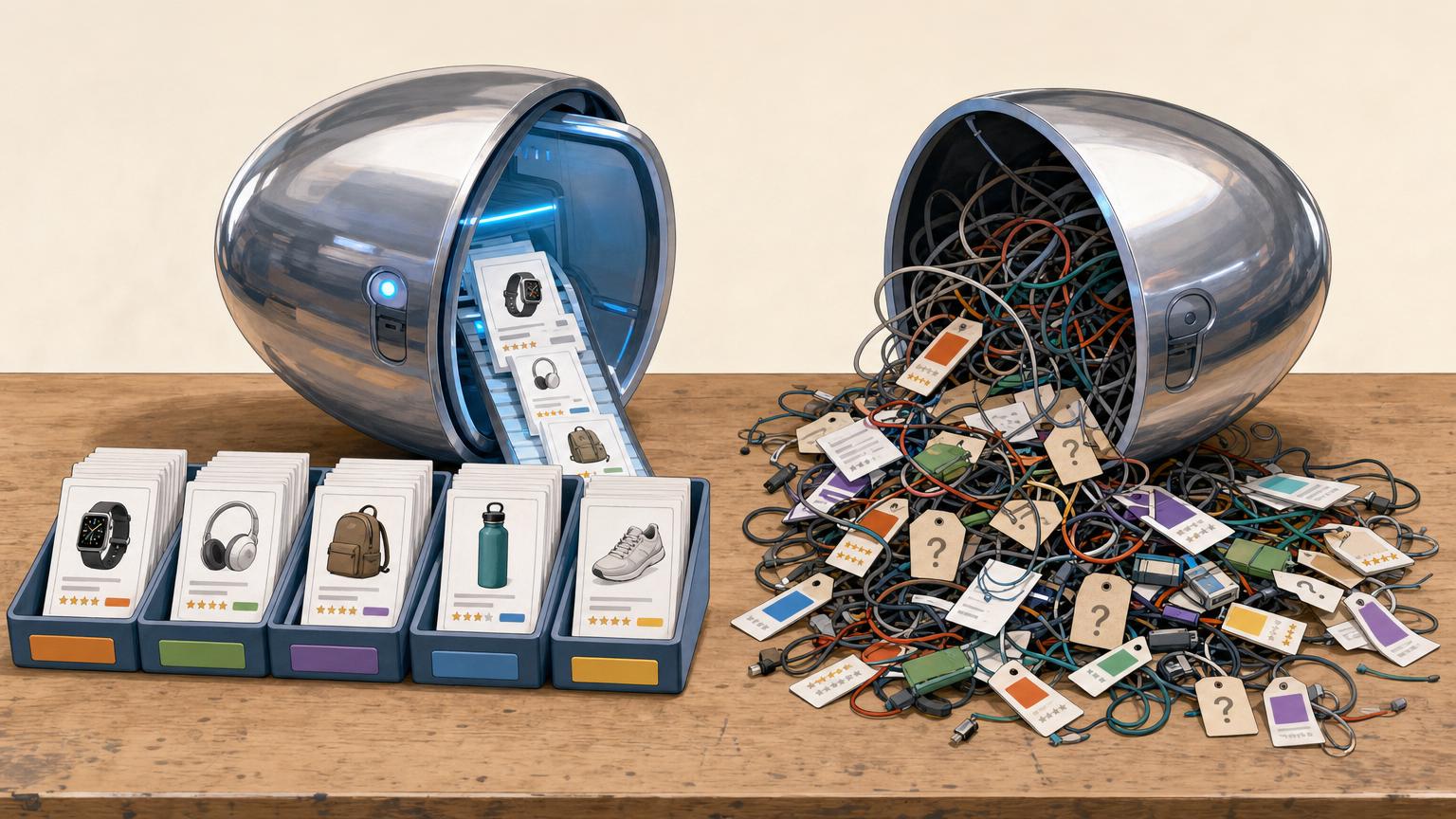


A single polished listing can hide the one detail that makes a purchase possible.
A shopper sees two nearly identical hiking jackets: same cut, same photo, nearly the same title. One has a waterproof membrane; the other is merely water-resistant. Folding them into one “variant” may make the catalog look tidy, but it turns a meaningful buying decision into a surprise after checkout.
Affiliate feeds often invite visual matching because images, brand names, and model families overlap. Yet similar is not interchangeable. Size is a normal variant when every other specification holds steady; a different material, capacity, connector, compatibility standard, warranty, or included accessory may change whether the item works at all. A merged page can also obscure price differences that have a real cause, making the cheaper option look like a bargain when it lacks the feature the shopper assumed was included. Clean data matters, but purchasing confidence matters more.
- The difference changes fit, function, compatibility, contents, or coverage.
- A shopper would reasonably compare the options as distinct products rather than selectable attributes.
Group related items without hiding the buying decision
Product family
A broad line built around the same idea, such as a trail shoe offered in several cuts or generations. Family grouping helps browsing, but does not mean every member is interchangeable.
Selectable variant
A choice within one purchasable model: size, colour, storage capacity, or a clearly stated configuration. It belongs under one listing only when the shopper can select it without changing the product’s essential identity.
Duplicate offer
Two merchants selling the same SKU, model, and configuration. These can be grouped as competing offers, leaving price, delivery, seller reputation, and warranty terms visible.
Separate product
An item that requires a new purchase decision because it changes fit, compatibility, included parts, performance, or intended use. Similar names and photos are not enough reason to combine it.
A feed can place a 128 GB and 256 GB device in one model page when capacity is an explicit choice. It should not quietly blend a Wi-Fi version with a cellular version, or a bare tool with a kit containing batteries and a charger.
Discovery can be shared; the purchase decision cannot. When records represent the same SKU, compare offers. When they represent different configurations, preserve the choice.
The substitution test
A practical question cuts through most borderline cases: could a shopper choose either listing without checking one more important detail? If the answer is no, they should remain separate variants—or separate products when the difference changes the item itself.
A red mug and a blue mug of the same size are usually interchangeable enough to group. A 12 oz mug and a 20 oz mug may not be: capacity affects use, price, and fit with a cup holder. The same applies to shoe width, connector type, regional plug, storage capacity, pack count, refill versus complete kit, and included accessories.
Treat feed data as clues
Merchant titles, images, and fields such as color, size, item_group_id, or GTIN help form a hypothesis; none settles it alone. A seller may put “bundle” in a title inconsistently, reuse a photo for several configurations, or assign one group ID to a loosely related range. Check whether several signals agree, especially specifications and manufacturer part numbers.
When fields conflict, preserve the distinction until it can be confirmed. This cautious approach follows rules for matching products across feeds: a false merge can hide the exact option a shopper needs, while an unmerged near-match is still visible for comparison.
A useful final check is to imagine the product page after grouping. If each option can be labelled clearly and selecting it changes only an expected variant attribute, merging is reasonable. If the selector would need a warning or an explanation, the listings are not safely substitutable.
Keep purchase-critical options visible
A product family can still share one parent listing, but fit and compatibility must remain selectable and obvious. These fields answer a different question from colour or pattern: not “which look is preferred?” but “will this work at all?”
Treat wrong-fit risk as a hard boundary
Do not collapse options when a shopper could receive an item that cannot be worn, connected, installed, or used. Common examples include:
- Left- versus right-handed golf clubs, gloves, tools, or door hardware
- Phone cases, screen protectors, and chargers matched to a specific device model
- Brake pads, wiper blades, filters, and accessories matched to a vehicle year, trim, or engine
- Plumbing, audio, power, and network items with different connector types or plug standards
- Helmets, car seats, toys, and clothing with age, size, or weight limits
A listing for “USB-C charger” is not safely interchangeable with one carrying a UK plug, an EU plug, or a US plug. Likewise, a case for an iPhone 15 may look nearly identical to one for an iPhone 15 Pro, yet fit neither device correctly.
When feeds provide these as variant attributes, retain them as distinct purchasable choices under a shared family. When the attribute is buried only in the title, description, or image, it deserves extra caution rather than automatic merging. A silent default—such as a preselected right-hand model or incompatible connector—turns a tidy catalogue into a wrong purchase.
Practical rule: if selecting the wrong option would require a return, adapter, alteration, or replacement, the option must remain visible.
Same model line, different buying outcome
Active ingredients, concentration, fragrance, or allergens can change who should use it.
Two moisturizers under one name may look identical, yet one contains retinol or a stronger acid. That affects sensitivity, routine compatibility, and whether the higher price delivers anything useful.
Steel grade, coating, fabric blend, and component quality can alter durability, care, and safety.
A pan with a different coating or a jacket with a waterproof membrane is not merely a different finish. Cleaning limits, expected lifespan, and intended conditions may all change.
Capacity, power, connectivity, and performance ratings often determine suitability.
Battery size affects runtime; storage affects what fits; a newer wireless standard may affect compatibility. If a shopper would compare the number before buying, it deserves its own selectable offer.
A colour-only variation can usually remain within one listing. But if the colour name also signals a different material, formula, capacity, or performance rating, split it into distinct variants and expose the affected specification near the price.
Count what the price buys
A lower price is not a better offer when it covers less product. A listing for one toothbrush head, for example, should not sit as the apparent equivalent of an eight-head multipack; nor should a 250 ml refill be collapsed into a 500 ml starter bottle. Count, volume, weight, and usable units belong in the variant label or offer details.
Bundle contents matter just as much. A camera body with a battery and charger is a different purchase from the same body bundled with a lens, memory card, and case. Accessories that merely decorate a photo can be secondary, but items that change what can be used on day one should stay visible. This is one reason to keep variants distinct in the browsing taxonomy, rather than letting a broad family hide the actual offer.
Make recurring prices unmistakable
Subscription feeds deserve an extra check. The displayed amount may be a first-delivery discount, a members-only rate, or the price per shipment rather than a one-off purchase. Show the cadence and terms alongside the price:
- Pack size: 1, 2, 6, or 12 units
- Refill quantity: volume, weight, or number of uses
- Kit contents: included core items and essential accessories
- Subscription: delivery interval, introductory price, and renewal price when supplied
If those details differ, the listings may be related, but they are not like-for-like offers.
Names can outlast the product
A familiar brand and base model name can span several genuinely different products. A 2021 model year may use an older processor, connector, sensor, or battery arrangement than a 2024 revision, even when listings reuse the same stock photo. Revised generations should remain separate unless the feed confirms the same manufacturer part number and specification.
Condition is not a cosmetic choice
New, used, refurbished, open-box, and manufacturer-renewed items are different offers. Condition can affect battery health, included accessories, cosmetic wear, return rights, and the length or source of warranty. A refurbished unit should not be presented as a cheaper colour or seller option beside a sealed new one.
Region and bundle can change usability
International editions may have different plugs, voltage ratings, languages, cellular bands, chargers, software features, or local certification. Even an apparently universal device can receive different support in another market.
Retailer-exclusive packages also deserve their own selectable variant when they add anything with real value or change the SKU, such as:
- an extra controller, lens, or refill;
- a larger storage or memory configuration;
- a subscription trial or downloadable content;
- different installation hardware or a retailer-backed protection plan.
Finally, warranty wording is part of the product offer. A manufacturer warranty, seller warranty, and no local warranty are not interchangeable. If support coverage differs by region, condition, or retailer, keeping the listings apart makes the trade-off visible instead of burying it behind one model name.
A title such as “Brand X Pro” may cover multiple generations and markets. Match the model number, release year, included items, and warranty territory before treating offers as equivalents.
Let the most durable evidence decide
A tidy title or matching studio photo can suggest a connection, but it should not settle one. For uncertain listings, require evidence that describes the purchasable item itself.
A matching GTIN, manufacturer part number, or exact seller SKU is the best basis for an offer-level match. For a variant relationship, a shared parent model plus distinct, documented option codes is stronger than a similar product name.
Match model compatibility, size system, capacity, material, pack count, connector, formula, and included pieces against the feed. Several agreeing fields are more convincing than one polished title or an image that may be reused across a range.
A conflicting specification should keep records apart until it is explained. If key fields are absent, leave the listing unmerged or send it for review; uncertainty is safer than creating a false option.
Images and names remain useful clues for finding candidates, not proof that candidates belong together.
Use a conservative release check
-
Confirm the shopper can switch without loss
A merged option should work for the same need, fit the same equipment, and carry no meaningful change in contents or terms.
-
Compare the specifications that define the item
Check dimensions, compatibility, material, formula, condition, age rating, and model or regional version—not just the headline.
-
Make the price comparable
Verify pack size, included accessories, refill amount, delivery or subscription conditions, and warranty source before treating offers as equivalent.
-
Follow the strongest feed evidence
GTINs, manufacturer part numbers, and reliable structured attributes deserve more weight than recycled titles or near-matching photos.
-
Keep uncertainty visible
When a field conflicts, is missing, or cannot be verified, leave the records separate or show them as distinct offers within a broader family.
A slightly untidy catalog is safer than a neat page that invites the wrong purchase.
Accuracy matters more than tidy grouping
- Treat an unproven match as a separate choice, not as harmless catalog noise.
- A family can still connect related products without claiming they are interchangeable.
Merging is appropriate only when the practical buying result stays the same. If safe substitution, defining details, included contents, price basis, or source data remain uncertain, preserving the distinction protects the shopper.
Clean catalog structure is useful only when it continues to describe the real choice at checkout.











30 responses to “When Affiliate Feed Product Variants Should Not Be Merged”
I’m slightly unsure about refills. A 30-count and 60-count pack are plainly not the same purchase, but should they live under one family page with pack size options, or as separate products for reporting purposes?
It feels like both views are useful: shoppers want to compare them, while analytics needs to know which quantity actually converted.
A family page can be appropriate when the refill itself is the same and quantity is a clear, selectable option. The individual pack-size configurations should still retain their own price, unit count, and identifiers, so reporting and offer comparison do not collapse them into one record.
Unit price should be prominent there too. Otherwise the 60-count looks “more expensive” even when it is the better deal per refill.
If two listings have conflicting capacity specs—say 128 GB in the title and 64 GB in the structured field—do you quarantine both, or can one be matched to a known product based on its GTIN?
A reliable GTIN can be strong corroborating evidence, but I would still flag the conflicting listing for correction and avoid publishing a misleading capacity. Match it only if the identifier is validated against a trustworthy source and the offer-level specification can be resolved; otherwise keep it separate or suppress it.
I’d add pet food formulas to the examples. Chicken vs salmon can sound like a flavour choice, but for an allergy household it is very much not a colour-level variant.
Good example. Formula and ingredient changes can alter suitability, dietary restrictions, and repeat-purchase expectations, so they should remain explicit configurations or separate records rather than being hidden under a generic product.
Same with caffeine-free versus regular coffee pods. The packaging can be nearly identical, which is a terrible little trap.
What about regional editions of books or board games? Same title and cover art, but one edition has different components or rule wording.
I’ve watched listings get merged because the ISBN was missing from one feed, then customers complained that the pictured expansion material was not included. Titles and images are really terrible evidence in that situation.
That is a strong case for separate records until the edition and contents can be verified. Regional edition, language, included components, and ISBN/other durable identifiers all affect substitutability; a matching cover should carry very little weight.
And printings can matter even within one region. A revised rulebook may fix errors, while an older copy has the same box photo floating around for years.
Exactly. If the revision changes contents or usable instructions, expose it rather than silently merging it. When the feed cannot establish which printing is being sold, uncertainty itself is a reason to keep the listing distinct.
A mild pushback: separate records can make browsing awful when every sock size and pack count becomes its own result. I agree that the options must stay visible, but the article could say more about how to prevent the conservative approach turning search into duplicate city.
I appreciate the warning against using images as proof. Merchants reuse lifestyle photos constantly, and sometimes the photo depicts accessories that are not included.
Would you recommend storing an evidence/confidence field per attribute? It seems much easier to explain why a merge was rejected if “bundle contents: unverified” is recorded instead of just a vague no-match result.
Yes, attribute-level evidence and confidence are very helpful. Record the source, timestamp, and whether a value came from a manufacturer specification, merchant feed, title, image, or inferred match. That creates an audit trail and lets a later, stronger source resolve only the uncertain attribute.
This also saves you when a merchant changes a listing without changing its URL. We learned that one the hard way.
The substitution test is a useful way to frame this. I’ve seen feeds merge two phone cases because the photos matched, even though one only fits the Pro model. That is not a “variant” once the buyer gets an unusable case.
Does warranty source belong in the product identity even if the physical item and SKU match? I’m thinking manufacturer warranty from an authorised dealer versus a marketplace import with seller-only coverage.
It may not change the physical object, but it can change the buying outcome enough to require clear separation at the offer level. If warranty coverage is materially different, avoid presenting the offers as interchangeable just because the SKU appears to match.
Yep. For cameras and power tools especially, that difference is worth real money. Calling them equivalent would be pretty misleading.
The model-year point is especially relevant to car accessories. Sellers love saying “fits 2018–2024,” then the actual connector changed halfway through that run. “Universal” is often marketing for “good luck.”
How do subscriptions fit this? A 12-pack bought once versus the same 12-pack on a recurring discount has the same contents, but the real price has conditions attached. I hate when comparison pages show the subscribe price as though anyone can just pay that once.
Treat the product contents as the same, but represent the recurring-price terms separately and prominently at the offer level. The displayed price should make the commitment, eligibility rules, and first-order versus ongoing price clear; otherwise it is not a fair offer comparison.
Especially when the first delivery is cheap and every later one jumps. That is not a small footnote.
For identical SKUs from multiple sellers, would you ever split them when the delivery date is dramatically different? Same item, but “arrives tomorrow” versus “ships in 3 weeks” can absolutely change my purchase decision.
They can remain competing offers for the same SKU, while delivery information is shown at the offer level. A delivery promise affects which seller a buyer chooses, but it does not usually create a different underlying product record.
How would you handle a product where the manufacturer uses one UPC for several colours, but the merchant has separate listings and one colour is consistently more expensive? Colour normally seems consequence-free, yet the offer clearly isn’t identical.
Keep the colour choice visible as a selectable variant, but do not treat the higher-priced colour as the same competing offer if its price is genuinely configuration-specific. The important distinction is between a colour that changes only preference and a colour selection that changes what the buyer pays.
This happens a lot with “special edition” colours too. Sometimes the colour name is doing sneaky work for a different material or finish, so I’d check the specs before assuming it’s just cosmetic.
Handedness is one of those fields people forget until they buy the wrong guitar pickguard or a left-handed tool. Glad it was called out directly.