

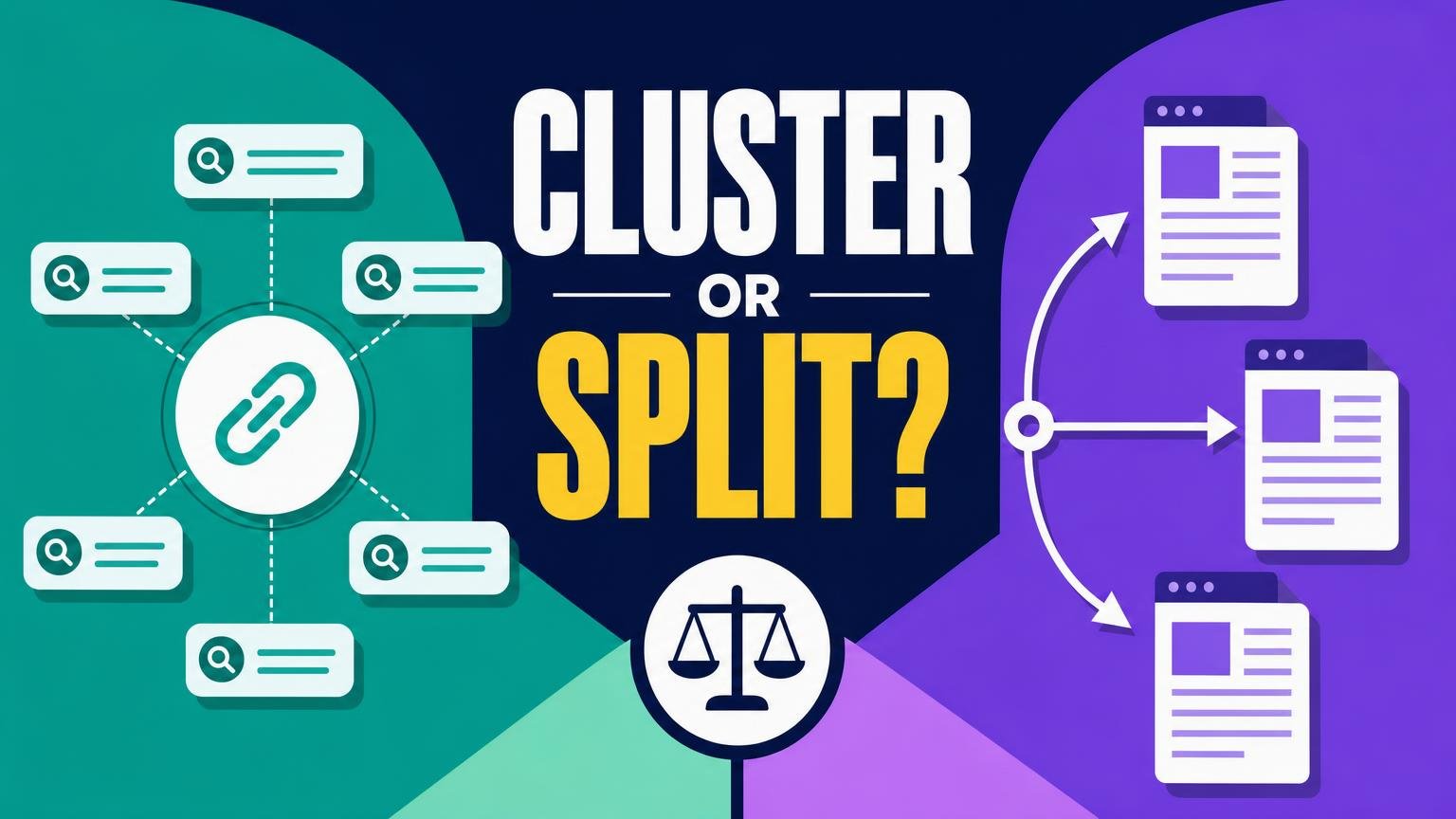
A long keyword list can look like a publishing plan when it is really a map of competing decisions.
A publisher researching “best hiking boots” may quickly collect “best waterproof hiking boots,” “hiking boots for wide feet,” “cheap hiking boots,” and dozens more. Creating a URL for every phrase can leave a site with thin pages that repeat the same recommendations. Putting every variation on one page creates the opposite problem: a crowded guide where a budget shopper, a winter hiker, and someone with wide feet all have to hunt for the answer.
The useful question is not how many keywords exist. It is: is the searcher trying to make the same choice? If the same shortlist, comparison criteria, and purchase path would satisfy several queries, they usually belong together. If a query calls for different products, different trade-offs, or advice that would change the final pick, it deserves its own page.
- One page can target several phrasings when the underlying recommendation remains the same.
- A separate page earns its place when its reader needs a meaningfully different shortlist.
Turn the export into an inventory
A raw export is easier to judge when each phrase is given a plain-language job. Sort terms first by the product or category named, then add the audience and commercial wording: “for beginners,” “under $50,” “best,” “review,” “vs,” or “near me.” These details often signal a different page need even when the core product matches.
A small worksheet is enough:
| Keyword | Implied task | Scope | Qualifier | Ranking-page type |
|---|---|---|---|---|
| best hiking boots for wide feet | choose a product | hiking boots | wide feet, best | comparison/list |
| hiking boot size guide | solve a fitting problem | hiking boots | size guide | guide/tool |
| waterproof hiking boots review | assess one option | hiking boots | waterproof, review | review |
The ranking-page type comes from a quick look at the results: lists, single-product reviews, category pages, guides, or retailer pages. It is only a working observation, but it prevents a review query from being casually folded into a broad buying guide.
Do not discard low-volume phrases simply because the export gives them a zero. A specific modifier can reveal an unmet concern, an emerging product feature, or wording worth including on a stronger page. Keep these in a separate “evidence” column and organize long-tail and zero-volume ideas alongside their broader parent term.
Merge spelling changes and word-order swaps only when the task and results look alike. Keep terms separate when a modifier changes the buyer’s question.
Give each page one buying job
A page should answer one clear question a shopper has at that moment. Matching the same broad product category is not enough. “Best cordless drills” and “cordless drill reviews” may both appear late in the journey, yet one needs a curated recommendation and the other needs evidence about a named model.
Separate pages when the decision changes
- Recommendation: a broad winner list, such as “best beginner telescopes.”
- Review: a close look at one product: strengths, limits, and who it suits.
- Comparison: a direct choice between two or more named options, such as “X vs Y.”
- Use-case shortlist: products selected for a situation, such as small apartments or camping.
- Pricing guidance: what a realistic budget buys, when price tiers matter, and worthwhile upgrades.
- Pre-purchase education: help choosing features or sizes before products can be judged.
A useful test is to write the page’s promised outcome in one sentence. A comparison promises a choice between named alternatives; a budget guide promises confidence at a spending level. If that sentence needs “and,” the candidate probably contains two intents.
There can still be overlap. A use-case shortlist may mention price, and a review may note alternatives. Those details support the central job; they should not turn the page into a second page type.
Let the results page settle close calls
-
Search each variation in a clean session
Check the main query and its closest variants without relying on personalized history where possible. Record the first-page URLs, visible titles, and result types rather than judging by wording alone.
-
Look for repeating ranking pages
If the same guides, category pages, reviews, or product pages recur across searches, the variations probably serve one need. A single page can usually cover them with natural headings and copy.
-
Compare the result format
Repeated “best” lists suggest a shared recommendation page; repeated product pages may indicate a tighter product-led need. Measure SERP similarity between keyword variations before treating overlap as conclusive.
-
Split when the evidence changes
Low URL overlap, different title promises, or a switch from listicles to comparisons, tutorials, or local results usually means searchers expect different pages.
-
Match the review method to the site
A small site can inspect results manually and note a few examples. Larger keyword sets benefit from clustering tools to flag likely groups, followed by manual checks for valuable or ambiguous terms.
No fixed overlap percentage settles every decision. When several prominent results repeat and present the same promise, clustering is a sensible starting point. Mixed result formats are a stronger warning than small differences in keyword wording.
Split pages when the qualifier changes the recommendation
“Best camping stove” can share a broad guide, but “best camping stove under $50” often cannot. A price ceiling removes capable models and makes value, compromises, and current pricing central evidence.
A “Brand X Trail 2 review” serves a reader close to one purchase. It needs hands-on details, alternatives, drawbacks, pricing context, and a clear verdict—not a brief mention inside a general list.
“Trail 2 vs Ridge 3” should split when readers need matched criteria: fit, weight, durability, price, and who should choose each. Its conclusion may differ from either product’s standalone review.
A broad “best hiking boots” page can cover several buyer types and link outward to budget, use-case, review, and comparison pages. Its job is selection, not exhaustive proof for every modifier.
Changing a title from best hiking boots to best hiking boots under $100 is not enough. The lower-price page should use a genuinely different shortlist, discuss price-driven trade-offs, and show why its picks beat nearby alternatives. If the verdict and proof stay the same, it is usually one page with a useful section—not two pages.
Build a map with no competing pages
A keyword decision is only useful once it becomes a content map. Give every planned URL one primary keyword, a small group of supporting variants, and one page type. Variants can reinforce the same page, but they should not quietly become reasons to publish another near-copy.
A simple map might look like this:
| URL | Primary keyword | Supporting variants | Page type |
|---|---|---|---|
/best-hiking-boots/ |
best hiking boots | top hiking boots, hiking boot recommendations | Best-list |
/best-budget-hiking-boots/ |
best budget hiking boots | cheap hiking boots, hiking boots under $100 | Budget list |
/hiking-boots-vs-trail-runners/ |
hiking boots vs trail runners | boots or trail runners | Comparison |
Each page needs a visibly different promise. The broad best-list can cover several price points and buyer types; the budget page should explain price limits, trade-offs, and value picks. The comparison should use matched criteria and end by saying who each option suits.
Keep the separation visible on the page itself:
- Write distinct titles and H1s that state the specific decision.
- Select products for that decision, rather than recycling the same ranked list.
- Use a conclusion with a different next action: choose a winner, stay under a budget, or pick between two categories.
- Add internal links where the reader’s question naturally changes, such as from the broad list to the budget list.
This makes related pages useful companions instead of rivals. A reader can move from “best overall” to a narrower need, while search engines receive clearer evidence that each URL serves a separate intent.
Keep the map useful after launch
Revisit the inventory every 60–90 days. Record each URL’s impressions, clicks, ranking queries, conversions, and the pages Google shows for those queries. Keep a cluster intact when one page ranks and converts across its terms with the same shortlist. Merge a weaker duplicate when two pages serve the same searchers; preserve useful links with a redirect. Split only when query patterns, product choices, or conversion behavior show a genuinely different buying job.
Add new queries to the same worksheet, then review where they belong before publishing. As the site expands, group related pages into a clear, browseable category structure so visitors can move from a broad recommendation to a focused comparison without hitting competing pages. The cycle is simple: inventory, publish, measure, revise, and repeat.











10 responses to “When to Cluster Affiliate Keywords and When to Split Pages”
I like the framework, although I think “one keyword focus per URL” can be misunderstood by newer SEOs. A page can have one primary buying job without pretending it only ranks for one exact phrase.
Otherwise people will split perfectly healthy synonym clusters into dozens of thin pages and call it strategy. The internet definitely needs fewer “best cordless widget for home” pages that differ by two adjectives.
Absolutely. “One keyword focus” here means one coherent intent and outcome, not one literal query. The goal is to prevent competing promises, not to create a URL for every modifier variation.
Thank you for saying this. The phrase gets repeated so often that it turns into a page-per-keyword rule, which is how content graveyards are born.
Could you clarify the “shared next action” test? I get shared products and scoring, but a comparison page might still end with “buy X” just like a best-of page. Does that automatically mean they should be combined?
Not automatically. The next action is only one part of the test. A head-to-head comparison asks the reader to choose between named options and needs direct trade-offs; a best-of page asks them to select from a broader evaluated field. Even if both ultimately recommend X, the decision process and evidence are different.
Yep, I learned this the hard way. My “Brand A vs Brand B” page got much better engagement after I stopped treating it like a mini best-of list and added scenario-based verdicts.
Step 3 didn’t work for me at first because I was labeling pages by keyword wording instead of the shopper’s outcome. Once I rewrote the columns as “needs a recommendation,” “needs a review,” or “needs a comparison,” the duplicate ideas became obvious. Slightly embarrassing how long I stared at the export before that 😅
The “one buying job” rule fixed a mess in our site map. We had one giant page trying to rank for best, cheap, and beginner-friendly espresso machines, and it never converted particularly well.
We split the budget angle into its own page and kept the main page recommendation-led. Rankings were a little wobbly at first, but the new pages make much more sense to actual visitors. This worked!
That is exactly the kind of split the rule is meant to surface. “Cheap” usually changes the acceptable product set and the proof needed, so it deserves its own promised outcome rather than a small section on a broad best-of page.
Same experience here with standing desks. The under-$300 list had almost nothing in common with the overall “best” shortlist once shipping and warranty were included.