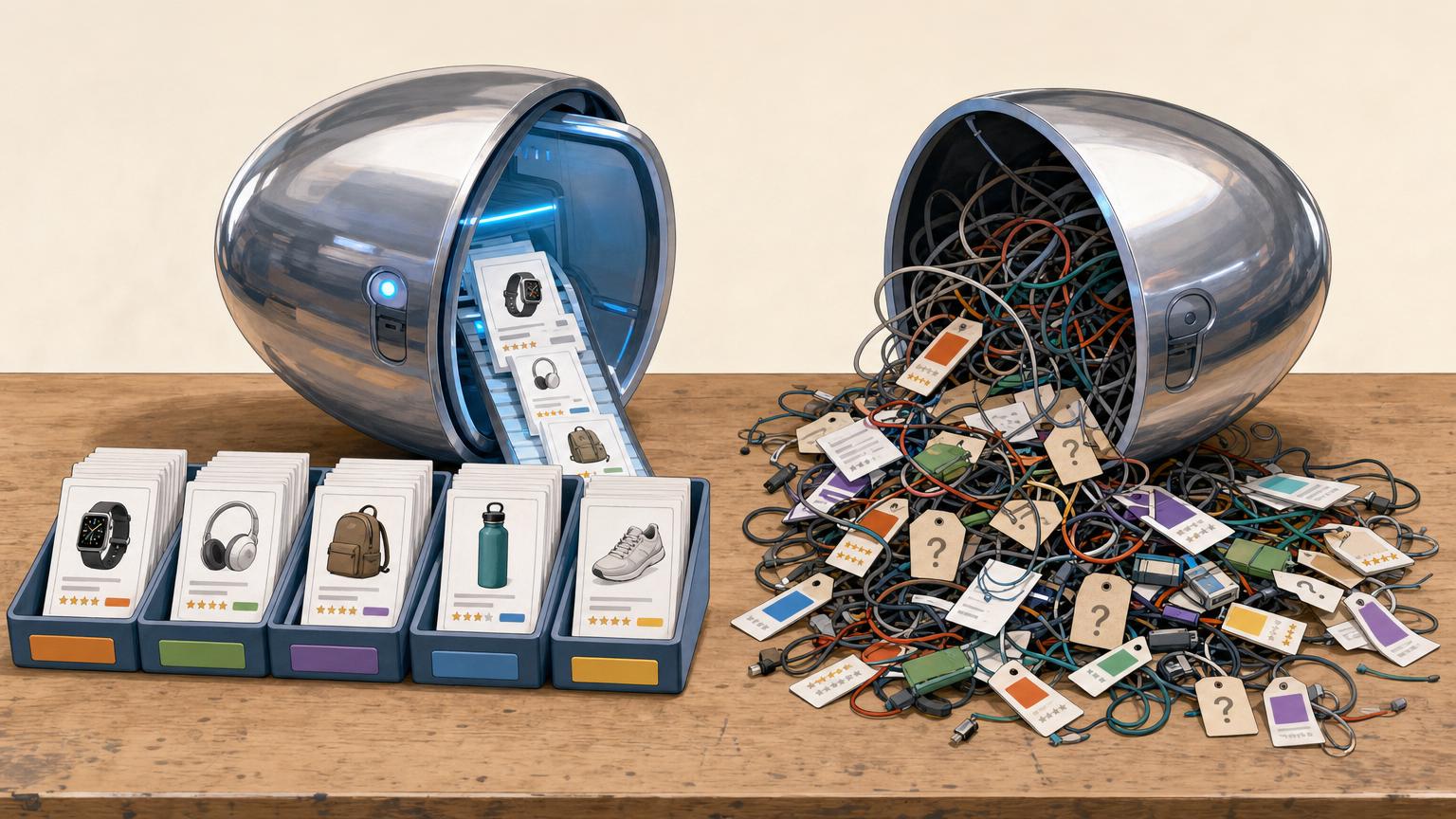

Smooth prose is not the same thing as reliable reporting.
A review can describe a camera’s “excellent low-light performance,” quote a battery life figure, and compare it with a rival model—all in a confident, natural voice—without any of it having been tested or checked. AI is especially good at making borrowed specifications, old launch information, and plausible-sounding conclusions read like firsthand experience.
That creates a real buyer risk. A discontinued feature may be presented as current, details from two product versions may be blended, or an invented limitation may steer someone away from a good purchase. Treat every AI-assisted review as an unverified draft, not evidence. Its value is speed: it can assemble a starting point and suggest claims worth investigating. Accuracy arrives only when those claims are traced to current, credible sources and any hands-on language is supported by actual use.
Turn the draft into a claim log
A long draft is difficult to verify as a whole. Break it into individual assertions: one feature, price, compatibility claim, test result, or comparison per line. This prevents a polished paragraph from hiding several unsupported details.
Use a simple spreadsheet or document table:
| Claim from draft | Type | Evidence needed | Source checked | Rewrite decision |
|---|---|---|---|---|
| “The earbuds last 10 hours” | Fact | Official battery specification | Product manual | Keep, add conditions |
| “They are comfortable for long sessions” | Opinion | Stated fit test or reviewer experience | Hands-on notes | Qualify |
| “Better than Model X” | Comparison | Matching test criteria | Test notes/spec sheets | Narrow or remove |
Facts include dimensions, supported formats, warranty terms, release dates, and measured performance. Each needs a source that can be cited or retained in editorial notes. Flag wording such as “always,” “best,” “first,” and “works with everything”; these often conceal claims that are broader than the evidence.
Opinions do not need to be disguised as facts, but they need a reason. Replace “The keyboard feels premium” with “Its aluminum top plate and low flex made it feel sturdier than the plastic alternatives tested.” If no basis can be recorded, cut the sentence.
Keep the original wording beside the revised version. That small paper trail makes later updates far less painful.
Precise details are often where AI reviews fail
Confirm the exact model number, configuration, and sales region.
A display option may exist only on a higher trim, a previous revision, or in another country.
Check the manufacturer’s current store page and note currency, tax treatment, promotions, and date.
Launch prices, sale prices, and regional pricing are easily blended into one misleading figure.
Verify supported operating systems, required versions, ports, subscriptions, and cited comparison criteria.
Compatibility often has exceptions, while “best” is a judgment unless the test conditions are stated.
Words such as all, only, first, best, and works with should trigger an extra source check. A single missing qualifier can turn an accurate sentence into a false promise.
Rank sources before trusting them
Not every source deserves equal weight. A polished retailer listing may be useful for spotting a claim, but it is weak proof when specifications, availability, or included accessories matter.
Start with the closest source
Use this order when checking each claim:
- Primary documentation: the manufacturer’s manual, technical specification sheet, support article, warranty terms, or official compatibility database.
- Official product page: useful for current positioning, colours, bundles, and headline features.
- Reputable independent testing: valuable for measured performance and real-world limitations.
- Major retailer listings: helpful for price snapshots and package contents, but prone to copied or outdated data.
- Forums, social posts, and AI summaries: leads only; confirm elsewhere before publishing.
Official pages are not automatically complete. Marketing copy may describe a feature without naming its limits, omit an older model’s restriction, or quietly change after a product refresh. Manuals and support pages often supply the missing conditions.
For every live page, record the exact product name, model or SKU, region, configuration, source URL, and date checked. “Model X” is rarely precise enough if the review concerns a 256 GB version, a 2024 revision, or a bundle sold only in one country. A dated note also makes later updates far easier: prices, firmware support, and stock can change overnight.
Verify the product identity before checking any claim
-
Start with the full model number
Record the manufacturer’s SKU, model code, or part number—not just the product family name. A single suffix can indicate different storage, ports, sensors, or included accessories.
-
Separate generation and configuration
Note the release year or generation, then list the relevant configuration: size, capacity, processor, color, connectivity, or battery option.
-
Pin down the sales region
Check the country or market named in the review. Regional editions may have different bands, chargers, warranty terms, software, or prices.
-
Treat bundles as separate products
A retailer bundle can add a dock, case, game, subscription, or upgraded accessory without changing the base product specification.
-
Search and cite the complete identifier
Use the exact model code plus region and configuration in searches. The same terms should appear in the citation note, so evidence can be matched to the reviewed item.
When the identifier cannot be confirmed, narrow the wording or omit the specification.
“Pro,” “2024,” “Gen 2,” and a trailing letter can signal a materially different product. Evidence for the base model does not automatically support a claim about the reviewed version. If a source lists only a family name, treat it as background evidence until the model code matches.
Keep evidence types separate
A review becomes misleading when a maker’s promise is written as though it were observed fact. Label each statement by where it came from: manufacturer specification, firsthand observation, or independent reporting. The wording should preserve that distinction.
For example, “rated for 20 hours” attributes a battery figure to the manufacturer. “Lasted about 16 hours in mixed use” requires a recorded test: product variant, settings, test conditions, and result. “Several established reviewers reported weak microphone performance” needs named, relevant sources rather than a vague consensus.
Claimed hands-on use deserves the highest bar. Keep notes, photos, measurements, or repeatable test details for the product details that need verification through testing. If no one involved handled the item, do not imply otherwise with phrases such as “in testing” or “the review found.” Attribute plainly: “According to the manual,” “the manufacturer states,” or “Reviewer X reported.”
Independent coverage can add useful context, but it should not be treated as proof of every claim. Check that the outlet tested the same model and that its conclusion is reported accurately, including any limits it noted.
A press-release feature is not a confirmed real-world benefit. A reviewer’s result is not a universal guarantee. Preserve the source’s level of certainty.
Check fast-changing claims last
A review can be accurate when drafted and misleading when published. Price, stock status, shipping estimates, subscription terms, promotions, and competitor lineups should therefore be checked in the final editorial pass—not copied forward from earlier research.
Record the retailer or manufacturer page, region, date, and any conditions that affect the result. A price may require a membership, trade-in, coupon, annual billing, or a particular color; “in stock” may mean available only from a marketplace seller.
Write claims that can survive change
Use dated, conditional wording when a fact is likely to move:
- “As checked on 12 June, the 256 GB version was listed at $499 in the US store.”
- “Shipping was estimated at three to five business days for the tested postcode.”
- “The free tier includes basic exports; advanced templates require a paid plan.”
Avoid durable-sounding claims such as “the cheapest option” unless the comparison is defined. State which products, which configuration, which region, and what measure was compared: upfront price, monthly cost, weight, battery rating, or included accessories.
For example, “Among the three 256 GB models checked from major US retailers on 12 June, it had the lowest listed price” says exactly what the evidence supports. If the comparison cannot be repeated cleanly, soften or remove it.
Rewrite claims to match the evidence
Weak support does not need a more confident replacement. If a claim cannot be backed by the right source, remove it, make it narrower, name who made it, or state the uncertainty. A review template that organizes verified claims makes these decisions visible rather than letting them disappear in revision.
Let the evidence set the strength
Small wording changes prevent a review from promising more than the research shows:
- Before: “The battery lasts all day.”
After: “In the manufacturer’s stated test, battery life reaches up to 12 hours; real-world use will vary.” - Before: “It works with any USB-C charger.”
After: “The manual lists USB-C charging, but compatibility with every charger was not confirmed.” - Before: “This is the best budget option.”
After: “Several reviewers praised its value, though no like-for-like comparison of current prices was available.”
Attribution matters when the evidence is someone else’s experience: “The company states,” “one reviewer found,” or “the manual does not specify” tells readers where certainty ends. If even a qualified sentence adds little, cutting it is stronger than leaving a vague claim behind.
Run a skeptical publication gate
-
Read each sentence as a doubtful buyer
Ask what proves it, which exact product it covers, and whether the wording says more than the source.
-
Open the supporting source again
Confirm that the page still exists and that price, availability, and conditions have not changed.
-
Test comparisons and verdicts
Remove “best,” “worth it,” or performance claims unless the comparison and criteria are clearly supported.
-
Separate commission from judgment
Affiliate potential is never evidence; disclose the relationship and keep the recommendation conditional.
-
Publish only defensible claims
If a claim cannot survive a skeptical challenge, narrow it, attribute it, or cut it.
- A polished sentence is not ready until its evidence, scope, and date hold up.
- A smaller, qualified recommendation is stronger than a confident unsupported one.
Publish for defensibility, not fluency. AI certainty and affiliate incentives cannot turn an unverified assertion into reliable advice.