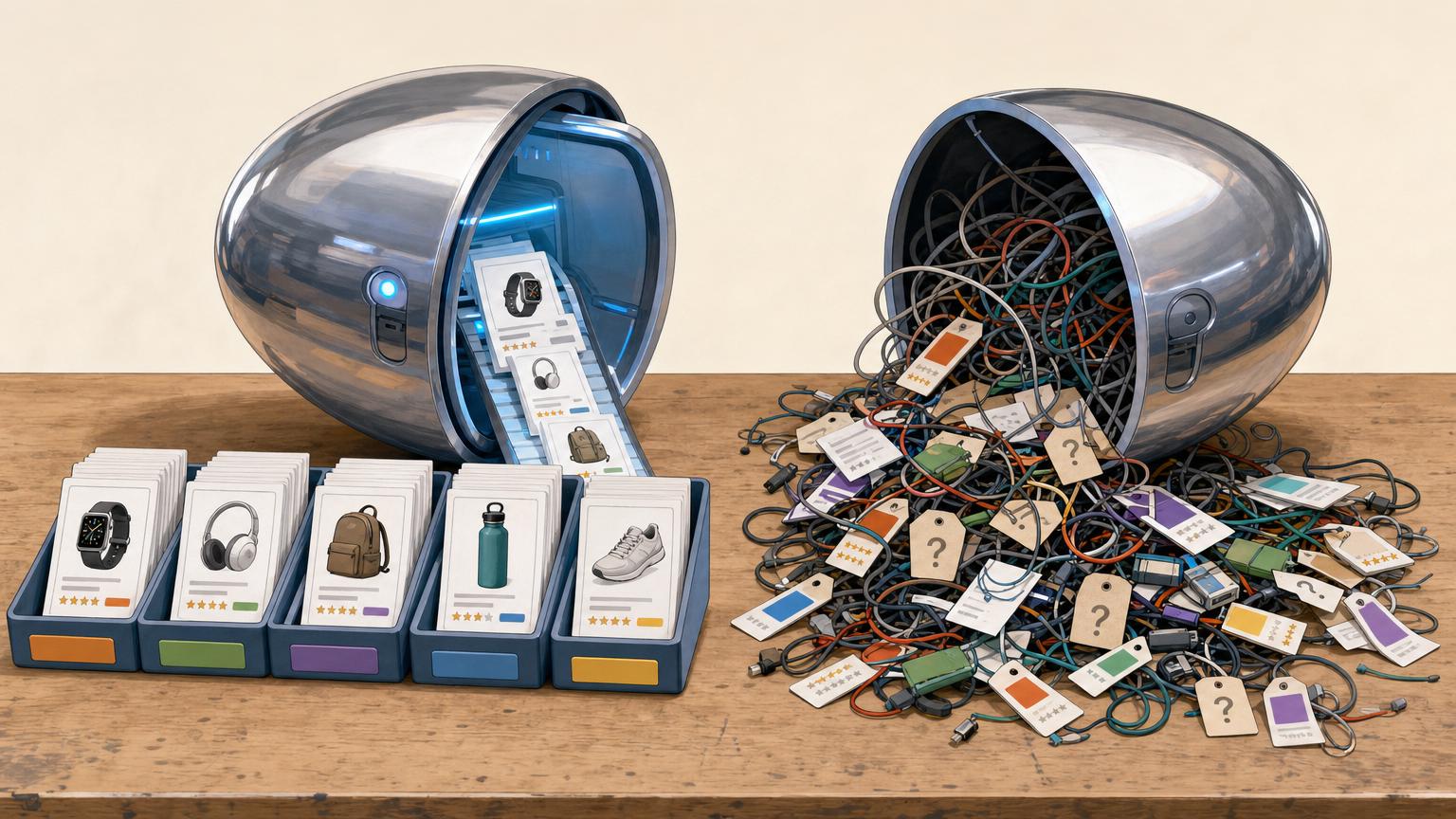


A crowded five-star rating can look more certain than it really is.
A writer opening a product page may find 4.8 stars from 12,000 ratings and a handful of glowing stories about a battery lasting all week. It is tempting to let those details stand in for hands-on testing. But an average conceals the spread: recent ratings may be worse, early reviewers may have received discounts, and a product can delight one type of owner while frustrating another.
Fair reporting treats reviews as a pool of imperfect evidence, not a rack of quotable praise. Note the number of ratings, read the newest and lowest-rated comments alongside the enthusiastic ones, and look for repeated specifics—such as a loose hinge, confusing setup, or reliable fit. A vivid complaint matters most when it recurs across independent reviews. If only a few comments were read, say so; do not turn selected anecdotes into a verdict.
- Compare the newest reviews with the overall rating; a high lifetime average can lag behind a recent quality change.
- Treat verified-purchase labels as a useful signal, not proof that every account is unbiased.
What reviews can—and cannot—support
Amazon reviews are consumer accounts, not controlled evidence. They can show that several purchasers noticed the same issue in ordinary use: a lid that leaks after a month, sizing that runs narrow, instructions that confuse first-time owners, or a finish that scratches easily. When those reports recur across recent, detailed reviews, they can fairly support cautious wording such as “some owners report” or “a recurring complaint is.”
They cannot establish that a product is safe, durable for everyone, medically effective, accurately rated, or better than a competitor. A five-star average is not a performance benchmark, and a cluster of complaints does not prove a defect; reviewers may use an item differently, receive different batches, or simply have different expectations.
Keep the claim proportional
Treat reviews as one labeled input alongside sources better suited to the claim:
- Safety and health: manufacturer documentation, regulators, qualified testing, or medical sources.
- Specifications and compatibility: official manuals and product pages, checked against the model number.
- Performance comparisons: independent testing with stated methods.
- Everyday ownership: recent review patterns, quoted accurately and with their limits clear.
This division keeps reader feedback useful without asking it to carry more weight than it can.
Check that the review belongs to the product
-
Start with the exact model number
Match the model or part number in the article to the one named on the listing, packaging, or manufacturer page. A similar product name is not enough: brands often reuse it across sizes and revisions.
-
Check the chosen variation
Confirm colour, size, capacity, material, and region-specific version. A complaint about a small battery, for example, may describe the lower-capacity option rather than the version under discussion.
-
Separate bundles from the main item
Reviews can reflect missing accessories, poor-quality included parts, or value for a multi-item pack. Those comments should not be presented as faults of the core product unless the article covers that bundle.
-
Watch for generations and altered listings
Amazon listings sometimes combine reviews from older generations or replace one version with another. Compare photos, specifications, and the “model” field; if the history is unclear, treat old reviews cautiously.
-
Use the review date as evidence, not decoration
Recent comments are more relevant after a redesign, firmware change, or supplier switch. Older reports can still be useful, but the wording should identify the version or time period: “reviews of the earlier model reported…”
-
Qualify findings when the match is uncertain
If a review does not clearly identify the version, it can support only a limited statement. Say that some listing reviews mention an issue, rather than claiming the current product has it.
A review is strongest when its model, variation, bundle status, and date all align with the product being described.
Build a sample that does not chase a verdict
-
Set a recent cutoff
Start with the newest 30–50 written reviews, or all recent reviews when the listing has fewer. Note the date range so an older complaint is not presented as current experience.
-
Take comments from every rating level
Read a similar number of recent reviews at each star level where available—for example, five each from one through five stars. This prevents a glowing average, or one angry review, from choosing the story.
-
Follow the article’s actual questions
Look for terms tied to the product’s relevant use: fit, charging, noise, durability, setup, or size. Record the claim beside the rating and date rather than collecting memorable quotations.
-
Count repeated reports in both directions
A theme is more useful when several independent reviewers mention it. Count praise and complaints separately: “easy setup” may recur often while “battery lasts all day” appears only occasionally.
-
Describe the strength of the signal
Use measured wording such as “several recent reviewers reported” or “a small number mentioned.” State when the sample is thin, ratings are uneven, or reports conflict.
A repeatable sample is not a survey. It is a way to keep review evidence proportional to what the listing actually shows.
A detailed one-star failure or ecstatic five-star endorsement can be worth quoting as an example, but not as proof of a common outcome. Before using it, check whether the same issue appears in other recent reviews and whether those reviews refer to the same version of the product.
Read trust markers with restraint
A Verified Purchase badge means Amazon records a purchase through its marketplace. That is helpful context, especially when the review describes details that fit the item, but it does not prove that the experience is typical, the product arrived unchanged, or every statement is accurate.
A Vine label is also information rather than a verdict. It discloses that the reviewer received the item through Amazon’s Vine program. The review may still contain useful observations; readers should simply remember that the reviewer did not buy the product in the ordinary way.
Reviewer histories can add context when they show varied, specific reviews over time. They are not identity checks, and a sparse profile is not evidence of wrongdoing. More useful warning signs appear in the review set itself:
- a sudden cluster of near-identical five-star wording;
- praise so generic it could fit almost any product;
- comments describing a different model, feature, or seller;
- repeated mentions of gifts, rebates, or requests for a review;
- a sharp rating shift with no visible product change.
These patterns justify cautious wording: the reviews look unusually repetitive or the rating may not reflect a stable sample. Calling reviews “fake” or alleging fraud requires stronger, independently supported evidence of deliberate deception. A strange pattern is a reason to investigate, not a finding of guilt.
In an article, report the marker that is visible and explain its limit. Avoid turning a badge—or its absence—into a claim about a reviewer’s honesty.
Turn a review sample into fair prose
A review sample is best presented as a reading of published comments, not a measurement of all buyers. The wording should say what was examined: the product variation, approximate date window, and the pattern found.
For example: “Among 20 recent reviews for the black 1-litre version, several owners praised the compact size, while a smaller number reported that the lid could drip when poured.” This tells readers that the observation is limited to a particular listing and period. It does not imply that every purchaser had the same experience.
Match the claim to the evidence
Useful phrasing includes:
- “Several reviewers mentioned…” for a repeated theme in a modest sample.
- “Some owners reported…” when accounts differ or the issue appears intermittently.
- “Recent reviews were mixed on…” when positive and negative comments recur.
- “In the reviews examined…” when the sample is informal rather than comprehensive.
Avoid upgrades such as “customers agree,” “the main problem,” or “most buyers,” unless a documented count genuinely supports them. A handful of comments can show that an issue exists; it cannot establish how common it is.
Variation matters too. A complaint about a white 500 ml model should not quietly become a claim about every size or colour. When findings conflict, preserve the conflict: “Ease of cleaning drew both praise and criticism, often depending on whether reviewers used a dishwasher.” That is more useful—and more honest—than forcing a verdict.
Quote reviews without distorting them
A review quote earns its place when its wording conveys something a summary would lose: a vivid description of fit, a specific setup snag, or a useful detail about daily use. Most review language is better paraphrased, especially when several customers make the same point.
Keep quotations short—usually a phrase or one sentence—and present them as an individual account, not a product fact. Preserve the surrounding meaning. A complaint such as “battery life is poor with GPS running” must not become a general claim that battery life is poor.
Credit without exposing people
Attribute the material plainly, for example: “One Amazon customer review posted in March 2024 described the latch as ‘stiff at first.’” Link to the relevant product listing when practical. A screen name is rarely necessary; omit real names, order details, locations, photographs, and other personal information unless there is a clear editorial reason to include them.
Avoid copying long passages or assembling many excerpts into a substitute for the review page. Quote selectively, paraphrase faithfully, and let the article’s own analysis explain how a comment fits the wider sample.
Before publishing, compare each paraphrase with the original review. Keep qualifiers, timeframes, and conditions that change its meaning.
Put customer sentiment in its place
A useful product article separates what is documented, what has been tested, and what owners commonly report. Those sources answer different questions. A manufacturer manual can establish rated capacity or included parts; it cannot prove that the capacity feels adequate in a busy kitchen.
Use an evidence ladder
- Primary documentation: manuals, specifications, warranty terms, and official compatibility lists support factual claims about the stated product.
- Independent expert testing: measured performance, durability checks, and controlled comparisons support stronger performance claims.
- Direct hands-on use: a writer’s dated observations can describe setup, handling, noise, or quirks encountered with a specific unit.
- Customer reviews: recurring reports help show how products behave across varied homes and over time.
The lower levels can add texture, but they should not fill a missing higher-level source. Ten complaints about a battery do not establish its measured runtime; a manual or credible test is still needed. Likewise, a stated feature is not evidence that owners find it useful.
When no direct testing is available, the honest route is to say so plainly. The article can report documented features and describe a carefully checked review pattern, while avoiding verdicts such as “best” or “reliable.” It should also note what remains unverified: long-term durability, comparative performance, or conditions that reviews did not describe.



A final fairness check
-
Match each claim to its evidence
A review can support an owner-reported experience, not a specification, safety conclusion, or universal verdict.
-
State the sample’s limits
Include the product variant, review period, and whether a theme appeared repeatedly or only once.
-
Remove borrowed certainty
Replace claims such as “it is unreliable” with “several recent reviewers reported reliability concerns.”
-
Keep star ratings in context
An average rating may describe broad satisfaction, but it does not prove performance on any particular feature.
-
Leave disagreement visible
If comments conflict, say so. A balanced account is more useful than a forced recommendation.
Use reviews as evidence with edges
- Revise any sentence that sounds stronger than the sample behind it.
- Attribute experiences to reviewers rather than presenting them as settled fact.
Amazon reviews can add practical detail when their scope, uncertainty, and disagreement remain visible. Transparent, proportionate language turns customer sentiment into useful context rather than borrowed proof.