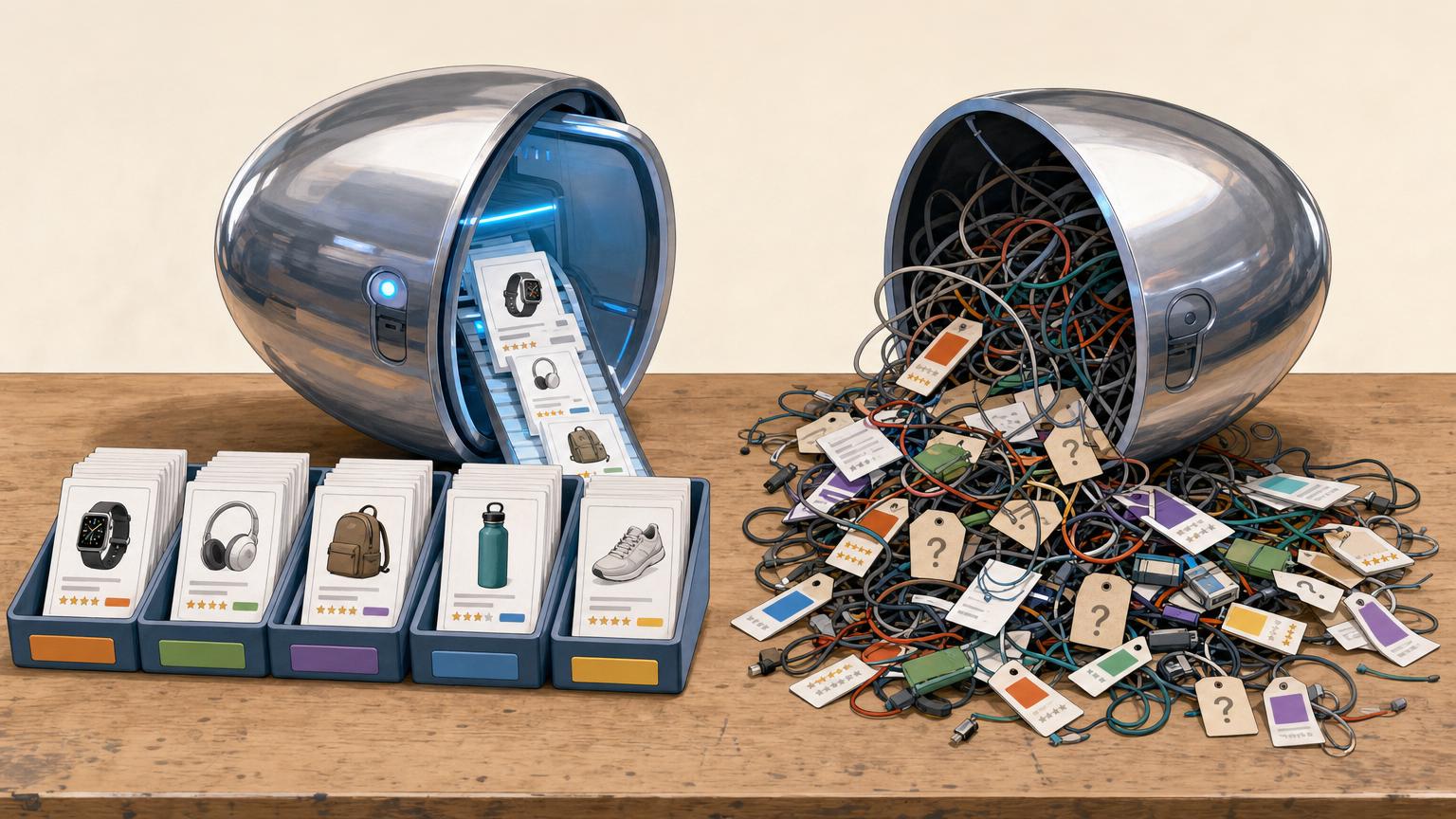

The same product name can lead to a completely different listing once an Amazon link crosses a border.
A reader in the UK clicks a well-meant Amazon.com recommendation for a camera battery, only to see “currently unavailable”—or a page for a bundle, capacity, or compatibility version that was never recommended. Changing .com to .co.uk rarely fixes it.
An ASIN is Amazon’s catalog identifier, but its practical meaning is tied to a particular national marketplace. The code may be absent in another store, assigned to a differently configured offer, or point to a listing whose sellers will not ship there. Even apparently universal goods—books, cables, skincare, replacement parts—can split into separate listings because of regional packaging, regulations, languages, plugs, or distribution rights. A broken overseas link is therefore usually not a typo in the web address; it is evidence that the local catalog does not share the same product identity.
- For safety-critical or compatibility-dependent items, match the model number, size, voltage, and included parts—not the title alone.
Four things that are easy to confuse
Physical product
The actual item: for example, a particular paperback edition, colour, size, or bundle. The same product can be offered in several Amazon stores, but that does not make its catalog identity global.
Marketplace listing
The product page in one Amazon marketplace, such as Amazon.com or Amazon.co.uk. Its title, images, seller offers, price, and availability may differ from the page for the same item elsewhere.
ASIN
Amazon’s catalog identifier for a listing in a particular marketplace. An ASIN found in one country is useful evidence when searching another, but it is not a universal product code and may be absent, reused for a variation, or lead to a different local listing.
Product URL
The web address that opens a specific marketplace page. A URL may contain an ASIN, yet it also carries the country domain and can include temporary search, referral, or campaign details.
Tracking parameter
Extra text added to a link so a source or campaign can be measured. It does not identify the product itself. For matching products without GTINs, compare edition details, brand, pack size, and images rather than treating a shared-looking link as proof.
Why matching products split across storefronts
A physical product has traits that travel with it: the model, colour, size, barcode, and what is in the box. That does not guarantee a shared Amazon record. Each national storefront maintains its own catalog, and similar submissions may be merged, separated, or corrected at different times.
The listing can change around the product
Local sellers may create the first detail page using different titles, images, brands, or package quantities. A UK multipack and a US single unit can look nearly identical in search results but deserve separate listings. Packaging also changes for local plugs, language, manuals, ingredients, safety labels, or regulatory claims; in those cases, the underlying item may genuinely be a different retail version.
Variation choices add another wrinkle. One marketplace may group every colour and size under a parent listing, while another gives a colour its own standalone page or connects only some variations. Brand owners can also decide which catalogue structure to use in each region, particularly after a relaunch or a change in authorised distribution.
A page is not an offer
It helps to keep three questions apart:
- What is the product? The real-world item and its exact configuration.
- What is the listing? A marketplace-specific catalog page, identified there by an ASIN.
- Is it available now? A live seller offer with a price, stock, delivery destination, and shipping eligibility.
A product page can exist in Amazon.de with no current offer, while the matching item is readily sold on Amazon.com under another ASIN. Conversely, a seller may offer an imported version that shares a product name but differs in warranty, packaging, or compliance.
When linking across countries, compare the brand, model or manufacturer part number, pack count, and variation first. Treat a matching title or image as a clue, not proof that two ASINs represent the same purchase.
Decide what counts as the same product
-
Start with the brand and model
Match the manufacturer and the actual model or part number first. A similar name, colour, or product photo is not enough when several versions share one family name.
-
Compare the specifications that affect use
Check size, capacity, material, power rating, connector type, included accessories, and any stated dimensions. For electronics, confirm voltage, plug type, wireless bands, and regional compliance where relevant.
-
Count what is in the box
A two-pack is not an exact substitute for a single item, even if its per-unit price looks attractive. Bundles, refill sizes, and starter kits deserve separate treatment.
-
Check the selected variation and condition
Amazon pages may group colours, sizes, styles, or storage capacities under one parent listing. Make sure the destination points to the intended child variation and matches new, used, renewed, or collectible condition.
-
Choose an alternative only when the difference is harmless
A clearly labelled regional alternative can work for a book edition with the same content, a replacement colour, or a locally packaged consumable with equivalent quantity. The link text should say what differs rather than implying an exact match.
-
Require an exact match when the detail changes the outcome
Use the precise model when compatibility, safety, fit, warranty, collector value, or promised features matter. Examples include batteries, camera lenses, vehicle parts, medical-adjacent items, and region-locked digital products.
When details cannot be verified, it is safer to describe the item as an alternative than to call it identical.
A model number is a strong starting point, not a complete guarantee. Manufacturers sometimes sell regional revisions under nearly identical names, with a different plug, included cable, language, warranty, or pack count.
For a destination link, exact match means the buyer receives the promised configuration. If that cannot be established, use plain wording such as “closest available regional version” and name the known difference.
Link the local detail page after checking the live option
-
Start in the destination marketplace
Switch to the country storefront that the reader will use, then search there by brand, model number, size, colour, pack count, or other identifying detail. A search result from another Amazon site is only a lead; it is not evidence of a local match.
-
Open the candidate listing and compare the essentials
Check the visible title, specifications, images, included quantity, and compatibility notes against the intended product. The local ASIN may differ, and that is normal, but the selected item still needs to meet the definition of “same” established earlier.
-
Select the exact purchasable variation
Choose the required size, colour, configuration, or bundle on the local page. Confirm that the variation controls, price area, and product details all describe that choice—not merely the parent family of related options.
-
Check that it can actually be bought there
Look for a live offer in the appropriate condition and, where relevant, delivery to the destination. An out-of-stock child, a used-only offer, or a listing restricted from shipping can make an otherwise accurate link unhelpful. This is also a sensible point to check international product links before publication.
-
Copy the local page only after the selection is set
Use the destination marketplace’s detail-page URL once the correct child variation is showing. A parent page can load with a different default for another visitor, especially when Amazon changes stock, pricing, or the preferred offer.
-
Test the link as a reader would
Open the copied URL in a fresh browser session and verify the storefront, chosen option, and buying status again. If it lands on a parent page or silently substitutes another variation, describe the product more cautiously or avoid presenting it as an exact match.
A local ASIN is useful only when its live detail page resolves to the intended purchasable option.
When the match is uncertain
A different ASIN can still be the same model when the manufacturer part number, included items, size or capacity, and relevant specification all line up. In that case, link the local page and say that it is the local listing for the same model. The ASIN itself does not need to match.
When one or more of those details differs, the safer description is recommended alternative. A newer revision, a different bundle, or a compatible replacement may be useful, but it should not be presented as the original product. A brief note such as “similar local option; includes a different charger” prevents a misleading substitution.
Sometimes verification is not possible because the exact item is unavailable, the page has disappeared, or the regional catalog is too vague. A local Amazon search link is then more honest than picking the first similar result. Search using the model number first; add a distinctive specification only if needed.
There are also cases where no purchase link is the responsible result: the item is discontinued, safety-critical details cannot be confirmed, or only used/refurbished offers remain when the reference is new. A plain availability note is more helpful than an invented match.
A practical label set keeps the distinction visible:
- Same model, local ASIN: details verified.
- Recommended alternative: meaningful difference disclosed.
- Search Amazon locally: exact listing not confirmed.
- No local link: no defensible option found.
Catalog pages, variation relationships, sellers, prices, and delivery eligibility can change without notice. Recheck the selected child variation and the current offer shortly before publishing or updating a link.
A correct destination comes before the tag
A product link has two separate jobs. First, it must open the right local listing: the intended model or clearly labelled substitute, in the shopper’s Amazon marketplace, with an offer that can actually be bought there. Only then does affiliate attribution matter.
A US detail-page URL with a US ASIN is not made useful for a UK shopper by adding a UK Associate tag. The page may not exist on Amazon.co.uk, may resolve to a different variation, or may have no deliverable offer. A tracking tag records a referral; it does not translate a catalog entry or create stock.
Treat each marketplace as its own link
For every destination, keep these pieces together:
- the local marketplace URL and its local ASIN;
- the checked variation, seller offer, and delivery status;
- the Associate ID approved for that marketplace, where applicable.
For example, a page for Amazon.de should use the verified German product URL and the German tracking ID. If no suitable German listing is available, an honest local search link, a labelled alternative, or no product link is better than sending readers to a dead end.
Link-localization tools can route visitors, but they still need sound inputs. Their tags may be helpful for reporting, yet they cannot repair a mismatched item, an unavailable offer, or a destination that was never checked.
A quick local-link check
-
Open the intended storefront
Confirm the country domain first. A valid-looking Amazon link is still wrong if it lands in another marketplace.
-
Check the product claim
Match the model, specifications, pack size, condition, and compatibility. If the local item is only a substitute, describe it as an alternative rather than the same product.
-
Select the exact variation
Choose the live child listing for the stated size, colour, capacity, or bundle. Parent pages and default selections can quietly point elsewhere.
-
Confirm availability and delivery
Make sure the item can currently be bought and delivered in the destination market. For seasonal, deal-driven, or fast-moving recommendations, repeat this check periodically.
-
Copy, test, and tag the final URL
Open the finished link in the local storefront, then add the matching local tracking ID. The published link should be the one that was actually verified.
A local ASIN is useful evidence, but the live local detail page is the publishing decision.
- Recheck volatile listings before major promotions, gift guides, or seasonal updates.
- When no verified local match exists, a plainly labelled alternative—or no product link—is more trustworthy than a forced ASIN match.
Amazon recommendations stay reliable when each destination is treated as its own live catalog. Link the exact product that has been checked in that storefront, at that time, and let the local URL and tracking tag follow that decision.