
Author: Serge
-
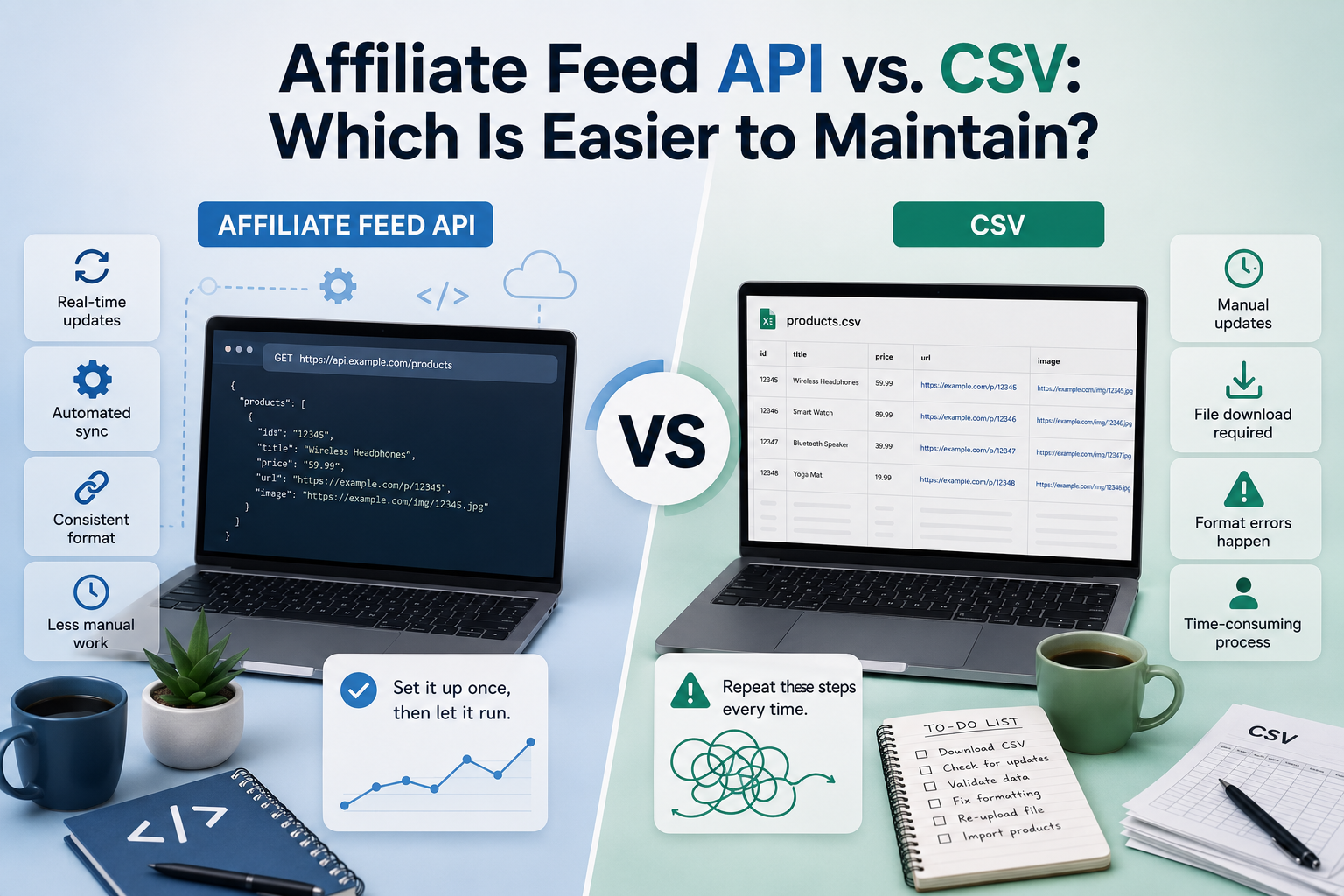
Affiliate Feed API vs. CSV: Which Is Easier to Maintain?
At first glance, CSV looks low-maintenance: fetch a file on a schedule, parse rows, map columns, and load the database. For small, stable catalogs updated once a day, that pipeline can stay pleasantly boring. The strain appears when the catalog grows or changes frequently. CSV is usually batch-oriented, so each refresh means downloading the whole…
-

Out-of-Stock Affiliate Links: What to Replace Automatically
Before any automation replaces a link, the target failure needs a label. A product that is briefly unavailable should not be treated like a dead page or a retired SKU. This is also the right moment to , since stale feeds often create unnecessary swaps. No single signal is safe enough on its own. Reliable…
-

How Affiliate Networks Work: What to Know Before Applying Anywhere
For merchants, a network solves several hard problems at once. It brings a ready-made pool of publishers, standard tracking links, contract templates, tax paperwork, and payment handling. Many also provide fraud screening, duplicate-order checks, and compliance monitoring for coupon abuse, trademark bidding, or incentivized traffic. For publishers, the appeal is just as practical: one login…
-

How to Build a Price Comparison Site That Can Be Monetized
Let payouts shape the product A comparison site built for affiliate CPA behaves differently from one built for lead generation, sponsored listings, or subscription data. The revenue event decides what must be prominent: clicks, form starts, tracked sales, or repeat logins. If that choice stays vague, templates usually drift toward attractive but low-earning pages. From…
-

Affiliate Content Automation: What to Automate First and Why
Volatile product facts—price, availability, coupon status, shipping windows, and ratings—are usually the smartest first automation target. They change often enough to damage trust and clicks, yet they arrive in predictable formats from feeds, APIs, or merchant exports. That makes them far safer to automate than recommendation copy or opinion-driven comparisons. Why this area produces quick…
-

What to Put in a Comparison Table for Faster Decisions
The right table begins by naming the decision it must speed up. A table for can serve very different moments: scanning the market, narrowing choices, or approving a final pick. Each moment changes what belongs in the rows and columns. For a shortlist, the desired outcome is simple: a small set of viable options worth…
-

Roundup Vs. Comparison Post: Which One Fits the Keyword?
A keyword is less a topic than a task signal. The wording usually reveals what the searcher needs the page to do next. The fastest way to confirm that task is the SERP contract: the pattern of pages already ranking. If search results are mostly listicles, search engines are signaling that the market expects exploration.…
-

Product Comparison Posts That Match Intent and Earn Clicks
Most comparison posts fail before the first paragraph: they compare two brand names simply because both are popular. Buyers rarely think that way. The useful angle is usually a decision tension — price vs capability, simplicity vs control, speed vs extensibility, or all-in-one convenience vs specialist depth. A strong post starts by naming the tradeoff…
-

How Often Affiliate Feeds Are Updated and Why It Matters
Some merchants push near-real-time APIs for price and availability, with changes visible in minutes. Others generate hourly deltas, nightly full exports, or manual files that appear only when someone remembers. A feed labeled daily may therefore mean anything from a predictable 2 a.m. rebuild to an inconsistent upload that slips by a day or two.…
-

How to Structure a Price Comparison Site When Products Fit Multiple Categories
Before menus, filters, or landing pages, the cleanest move is to model the product as the stable record. Everything else—categories, merchant offers, specs, tags, and editorial collections—should point back to that record instead of competing to define it. When a laptop appears under “gaming,” “student,” and “16 GB RAM,” the problem is rarely a broken…
Latest Posts





About the Author

Serge
Serge is an affiliate marketer with 20 years in the field and a WordPress plugin developer. He writes about building, ranking, and monetizing affiliate sites — drawing on tools he’s actually built and used, not just reviewed.
You May Have Missed